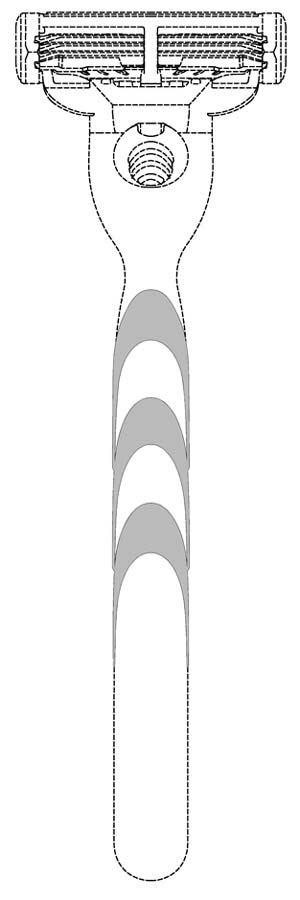
A hair removal device is provided including a hair removal surface having a first perimeter and a multi-angle deflector having a second perimeter greater than or equal to the first perimeter wherein the multi-angle deflector is coupled to the hair removal surface. The device includes an applicator head having a third perimeter greater than or equal to the first perimeter, wherein the hair removal surface is coupled to the multi-angle deflector via the applicator head. The device includes a base, having a fourth perimeter coupled to the multi-angle deflector, wherein the third perimeter is greater than or equal to the fourth perimeter. A base-deflector connection portion is coupled to a deflector-base connection portion, an applicator-deflector connection portion is coupled to a deflector-applicator connection portion, the multi-angle deflector provides multidirectional deflection connection of the applicator head relative to the base, and the fourth perimeter encircles the base-deflector connection portion.
A delivery management method is provided. An input is received indicating a consumer product for a subscription. An output is provided indicating the consumer product subscription. Information is communicated to a dispatching entity to dispatch the first shipment. A request is received for a second shipment. A time period between the first shipment and the received second shipment request is compared with a predetermined time period or a time of the received request is compared with a subscription time period. If the time period is greater than or equal to the predetermined time period, information is communicated to dispatch the second shipment. If the time period is less than the predetermined time period or if the time of the received request is after expiration of the subscription time period, information is communicated to reject the second shipment.
G06Q 20/10 - Payment architectures specially adapted for electronic funds transfer [EFT] systemsPayment architectures specially adapted for home banking systems
9.
METHOD OF ASSEMBLING AND TESTING A PRESSURIZED CONSUMER PRODUCT
A method of assembling and testing a consumer product by sealing a liner around a body of a valve. A fluid dispensing assembly is formed by sealing the liner and at least a portion of the valve within a container. The container is pressurized. The liner is filled with a liquid. A heat source is applied to the fluid dispensing assembly. The fluid dispensing assembly is cooled by removing the fluid dispensing assembly from the heat source. The temperature of the fluid dispensing assembly is measured after the removing the heat source. The temperature of the fluid dispensing assembly is compared to a predetermined temperature.
A method of assembling and testing a consumer product by sealing a liner around a body of a valve. A fluid dispensing assembly is formed by sealing the liner and at least a portion of the valve within a container. The container is pressurized. The liner is filled with a liquid. A heat source is applied to the fluid dispensing assembly. The fluid dispensing assembly is cooled by removing the fluid dispensing assembly from the heat source. The temperature of the fluid dispensing assembly is measured after the removing the heat source. The temperature of the fluid dispensing assembly is compared to a predetermined temperature.
This invention relates to a shaving assembly or hair removal device is disclosed. The shaving assembly has one or more cutting edges and one or more receiving volumes. At least one of the one or more receiving volumes comprises a shaving aid and a retention member.
B26B 21/44 - Means integral with, or attached to, the razor for storing shaving-cream, styptic, or the like
B26B 21/02 - Razors of the open or knife typeSafety razors or other shaving implements of the planing typeHair-trimming devices involving a razor-bladeEquipment therefor involving unchangeable blades
B26B 21/22 - Safety razors with one or more blades arranged transversely to the handle involving several blades to be used simultaneously
A shaving cartridge with a housing defining a first pocket, a second pocket and a window dimensioned to receive one or more blades. The housing having a leading platform. A blade mounted within the window. A guard in front of the blade. A cap behind the blade. The leading skin bar includes a shaving aid composition. The leading skin bar is mounted to a first surface of the leading platform. The shaving aid composition extends from the first surface into a second through hole of the first pocket, and into the first pocket. The second through hole extends in a direction between the guard and the cap.
A consumer product package with a cavity dimensioned to receive a product. The consumer product package has a first panel and a second panel extending in a transverse direction from the first panel. An edge is positioned between the first panel and the second panel. A first weakened portion defines a tear away region to expose the cavity. The second weakened portion extends from the edge into at least a portion of the first panel. A second weakened portion defines a punch out tab extending from the edge into at least a portion of the second panel. A third panel is positioned over the second panel. The third panel defines a cut away region exposing the punch out tab. The punchout tab and the tear away region are integral.
A shaving cartridge with a housing defining a first pocket, a second pocket and a window dimensioned to receive one or more blades. The housing having a leading platform. A blade mounted within the window. A guard in front of the blade. A cap behind the blade. The leading skin bar includes a shaving aid composition. The leading skin bar is mounted to a first surface of the leading platform. The shaving aid composition extends from the first surface into a second through hole of the first pocket, and into the first pocket. The second through hole extends in a direction between the guard and the cap.
In one aspect, the invention features, in general, a shaving cartridge with a housing having a guard and a cap. At least one blade is mounted to the housing. The at least one blade has a cutting edge positioned between the guard and the cap. A leading skin bar extends forward of the guard. The leading skin bar includes an upper skin facing surface with an arcuate forward edge closest to the cutting edge toward a center axis of the leading skin bar and further away from the cutting edge toward a pair of opposing lateral ends of the housing. A length of the arcuate forward edge measured parallel to the at least one blade is greater than or equal to 60% of a length extending between the pair of opposing lateral ends.
A consumer product package (10) with a cavity (25) dimensioned to receive a product (15). The consumer product package has a first panel (12) and a second panel (14) extending in a transverse direction from the first panel. An edge (18) is positioned between the first panel and the second panel. A first weakened portion (24) defines a tear away region (26) to expose the cavity. The second weakened portion (44) extends from the edge into at least a portion of the first panel. A second weakened portion defines a punch out tab (46) extending from the edge into at least a portion of the second panel. A third panel (16) is positioned over the second panel. The third panel defines a cut away region (22) exposing the punch out tab. The punchout tab and the tear away region are integral.
B65D 5/42 - Details of containers or of foldable or erectable container blanks
B65D 5/54 - Lines of weakness to facilitate opening of container or dividing it into separate parts by cutting or tearing
B65D 5/02 - Rigid or semi-rigid containers of polygonal cross-section, e.g. boxes, cartons or trays, formed by folding or erecting one or more blanks made of paper by folding or erecting a single blank to form a tubular body with or without subsequent folding operations, or the addition of separate elements, to close the ends of the body
In one aspect, the invention features, in general, a shaving cartridge with a housing having a guard and a cap. A plurality of blades is positioned between the guard and the cap. Each of the blades has a cutting edge. The cutting edges defining a shave plane. A leading skin bar extends in front of the guard. The leading skin bar has a concave skin facing surface when viewed in cross section along a center axis of the leading skin bar that is transverse to the shave plane.
In one aspect, the invention features, in general, a shaving cartridge with a housing having a guard and a cap. At least one blade is mounted to the housing. The at least one blade has a cutting edge positioned between the guard and the cap. A leading skin bar extends forward of the guard. The leading skin bar includes an upper skin facing surface with an arcuate forward edge closest to the cutting edge toward a center axis of the leading skin bar and further away from the cutting edge toward a pair of opposing lateral ends of the housing. A length of the arcuate forward edge measured parallel to the at least one blade is greater than or equal to 60% of a length extending between the pair of opposing lateral ends.
This invention relates to a shaving assembly or hair removal device is disclosed. The shaving assembly has one or more cutting edges and one or more receiving volumes. At least one of the one or more receiving volumes comprises a shaving aid and a retention member.
GFD GESELLSCHAFT FÜR DIAMANTPRODUKTE MBH (Germany)
Inventor
Gluche, Peter, Bodo
Gester, Matthias
Abstract
The present invention relates to a method of etching a substrate. The method comprises providing a substrate and a structure transfer member. Prior to etching, the structure transfer member will have a profile. The etching transfers the profile from the structure transfer member to the substrate by simultaneously etching both materials.
Razors and razor blades; dispensers, cassettes, holders, and
cartridges, all specifically designed for and containing
razor blades; parts and fittings for all the aforesaid
goods.
A razor blade with a sharpened cutting edge with an outer bonding surface. A phosphonate polysiloxane composite layer deposited on the outer bonding surface forming an outermost layer of the sharpened cutting edge. The phosphonate polysiloxane composite layer is composed of one or more layers. The phosphonates are covalently bonded to the outer bonding surface. The siloxanes are covalently bonded to the phosphonates and in some applications are also covalently bonded to the outer bonding surface. The siloxanes are a reactive silicone polymer, bonded to the phosphonates or outer bonding surface creating branches, mild crosslinking or even heavily crosslinked layers. The phosphonate polysiloxane composite may be formed through the use of thermal, UV exposure, IR exposure, a combination of thermal, UV, and or IR, as well as e-beam, ion-beam, or other ionization source.
A razor blade with a sharpened cutting edge with an outer bonding surface. A phosphonate polysiloxane composite layer deposited on the outer bonding surface forming an outermost layer of the sharpened cutting edge. The phosphonate polysiloxane composite layer is composed of one or more layers. The phosphonates are covalently bonded to the outer bonding surface. The siloxanes are covalently bonded to the phosphonates and in some applications are also covalently bonded to the outer bonding surface. The siloxanes are a reactive silicone polymer, bonded to the phosphonates or outer bonding surface creating branches, mild crosslinking or even heavily crosslinked layers. The phosphonate polysiloxane composite may be formed through the use of thermal, UV exposure, IR exposure, a combination of thermal, UV, and or IR, as well as e-beam, ion-beam, or other ionization source.
A razor blade with a sharpened cutting edge with an outer bonding surface. A phosphonate polysiloxane composite layer deposited on the outer bonding surface forming an outermost layer of the sharpened cutting edge. The phosphonate polysiloxane composite layer is composed of one or more layers. The phosphonates are covalently bonded to the outer bonding surface. The siloxanes are covalently bonded to the phosphonates and in some applications are also covalently bonded to the outer bonding surface. The siloxanes are a reactive silicone polymer, bonded to the phosphonates or outer bonding surface creating branches, mild crosslinking or even heavily crosslinked layers. The phosphonate polysiloxane composite may be formed through the use of thermal, UV exposure, IR exposure, a combination of thermal, UV, and or IR, as well as e-beam, ion-beam, or other ionization source.
C23C 28/00 - Coating for obtaining at least two superposed coatings either by methods not provided for in a single one of main groups , or by combinations of methods provided for in subclasses and
A razor blade with a sharpened cutting edge with an outer bonding surface. A phosphonate polysiloxane composite layer deposited on the outer bonding surface forming an outermost layer of the sharpened cutting edge. The phosphonate polysiloxane composite layer is composed of one or more layers. The phosphonates are covalently bonded to the outer bonding surface. The siloxanes are covalently bonded to the phosphonates and in some applications are also covalently bonded to the outer bonding surface. The siloxanes are a reactive silicone polymer, bonded to the phosphonates or outer bonding surface creating branches, mild crosslinking or even heavily crosslinked layers. The phosphonate polysiloxane composite may be formed through the use of thermal, UV exposure, IR exposure, a combination of thermal, UV, and or IR, as well as e-beam, ion-beam, or other ionization source.
C23C 28/00 - Coating for obtaining at least two superposed coatings either by methods not provided for in a single one of main groups , or by combinations of methods provided for in subclasses and
Razors and razor blades; dispensers, cassettes, holders, and
cartridges, all specifically designed for and containing
razor blades; parts and fittings for all the aforesaid
goods.
(1) Razors and razor blades; dispensers, cassettes, holders, and cartridges, all specifically designed for and containing razor blades; parts and fittings for all the aforesaid goods.
Razors and razor blades; dispensers, cassettes, holders, and cartridges, all specifically designed for and containing razor blades; parts and fittings for all the aforesaid goods.
A shaving razor system having a shaving razor handle that includes a proximal end, a distal end, an upper surface extending between the proximal end and the distal end. The upper surface having a generally convex profile. The shaving razor handle has a lower surface extending between the proximal end and the distal end. the lower surface has a generally concave profile. A shaving razor cartridge releasably is mounted to the proximal end of the shaving razor handle. A cartridge ejection button is positioned on the lower surface towards the proximal end.
A shaving cartridge dispenser with a base, two side walls, a front wall, and a rear wall. The side walls extend upwards from the base. The front and the rear walls extend upward from the base, between the side walls. A first divider between the front wall and the rear wall extends at least part way between the two side walls. The first divider and the rear wall at least partially define a first chamber sized and shaped to receive a first shaving cartridge. The first divider defines a first open slot. A second divider is located between the first divider and the front wall and extends at least part way between the two side walls. The second divider and the first divider at least partially define a second chamber sized and shaped to receive a second shaving cartridge. The first chamber is in communication with the first open slot.
B65D 81/26 - Adaptations for preventing deterioration or decay of contentsApplications to the container or packaging material of food preservatives, fungicides, pesticides or animal repellants with provision for draining away, or absorbing, fluids, e.g. exuded by contentsApplications of corrosion inhibitors or desiccators
A shaving cartridge dispenser with a base, two side walls, a front wall, and a rear wall. The side walls extend upwards from the base. The front and the rear walls extend upward from the base, between the side walls. A first divider between the front wall and the rear wall extends at least part way between the two side walls. The first divider and the rear wall at least partially define a first chamber sized and shaped to receive a first shaving cartridge. The first divider defines a first open slot. A second divider is located between the first divider and the front wall and extends at least part way between the two side walls. The second divider and the first divider at least partially define a second chamber sized and shaped to receive a second shaving cartridge. The first chamber is in communication with the first open slot.
Digital imaging systems and methods are described for analyzing pixel data of an image of a skin area of a user for determining body contour. A plurality of training images of a plurality of individuals are aggregated, each of the training images comprising pixel data of a respective skin area of an individual. A body contour model, trained with the pixel data, is operable to output, across a range of a body contour scale, body contour values associated with a degree of body contour. An image of a user comprising pixel data of at least a portion of a user skin area is received and analyzed, by the body contour model, to determine a user-specific body contour value of the user skin area. A user-specific electronic recommendation addressing at least one feature identifiable within the pixel data is generated and rendered, on a display screen of a user computing device.
G16H 30/40 - ICT specially adapted for the handling or processing of medical images for processing medical images, e.g. editing
G16H 50/20 - ICT specially adapted for medical diagnosis, medical simulation or medical data miningICT specially adapted for detecting, monitoring or modelling epidemics or pandemics for computer-aided diagnosis, e.g. based on medical expert systems
The present invention relates to a cutting element formed from a composite of a substrate coated with a structured coating comprising a substrate with a surface in contact with the coating. The substrate has a plurality of substrate recesses at least in regions of the substrate surface. The coating extends into the recesses of the substrate, and the coating has an inner surface being in contact with the substrate and an outer surface opposite to the inner surface. The coating comprises at the outer surface a plurality of coating recesses being smaller than the recesses at the surface of the substrate resulting in a structured coating. Moreover, the present invention relates to a method for producing a cutting element.
B23B 27/14 - Cutting tools of which the bits or tips are of special material
C23C 20/00 - Chemical coating by decomposition of either solid compounds or suspensions of the coating forming compounds, without leaving reaction products of surface material in the coating
A consumer product package is provided. The consumer product package includes a first container having a first inner wall that defines a first compartment and a first outer wall. The consumer product package also includes a second container having a second inner wall that defines a second compartment that faces the first compartment in a closed position and a second outer wall. The consumer product package also includes a first consumer product removably secured within the first compartment. The consumer product package also includes a second consumer product removably secured within the second compartment. A magnetic connection between the first consumer product and the second consumer product secures the first container to the second container in the closed position. A method of assembly of the consumer product package is also provided.
B65D 5/00 - Rigid or semi-rigid containers of polygonal cross-section, e.g. boxes, cartons or trays, formed by folding or erecting one or more blanks made of paper
A45D 27/22 - Containers or carriers for storing shaving appliances
B65D 43/16 - Non-removable lids or covers hinged for upward or downward movement
B65D 75/22 - Articles or materials wholly enclosed in single sheets or wrapper blanks in sheets or blanks doubled around contents and having their opposed free margins united, e.g. by pressure-sensitive adhesive, crimping, heat-sealing, or welding the sheet or blank being recessed to accommodate contents
B65D 77/00 - Packages formed by enclosing articles or materials in preformed containers, e.g. boxes, cartons, sacks or bags
The present invention is directed to a shaving apparatus. The shaving apparatus includes a flexible substrate and a plurality of treatment sheets, each treatment sheet comprising at least one first aperture, at least one first aperture comprising cutting edges, wherein the plurality of treatments sheets are secured to said flexible substrate. The flexible substrate allows the treatment sheets to move in response to a force applied during hair removal.
B26B 21/20 - Safety razors with one or more blades arranged transversely to the handle involving blades with more than two cutting edgesSafety razors with one or more blades arranged transversely to the handle involving disc blades
B26B 21/56 - Razor-blades characterised by the shape
69.
COMPOSITE OF A SUBSTRATE COATED WITH A MECHANICALLY INTERLOCKED COATING, CUTTING ELEMENT AND METHOD FOR DEPOSITING A MECHANICALLY INTERLOCKED COATING UPON A SUBSTRATE
The present invention relates to a composite of a substrate coated with a mechanically interlocked coating having a substrate with a surface in contact with a coating. The substrate has at least in regions of the surface a plurality of recesses at the surface and the coating extends into the recesses of the substrate forming a mechanical interlocking structure between the substrate 10 and the coating. Moreover, the present invention relates to a cutting element formed from the composite and a method for depositing a mechanically interlocked coating upon a substrate.
The present invention is directed to a shaving apparatus. The shaving apparatus includes a flexible substrate and a plurality of treatment sheets, each treatment sheet comprising at least one first aperture, at least one first aperture comprising cutting edges, wherein the plurality of treatments sheets are secured to said flexible substrate. The flexible substrate allows the treatment sheets to move in response to a force applied during hair removal.
A shaving razor handle with a proximal end configured to attach to a shaving razor cartridge. A terminal end is opposite the proximal end. A distal end portion is located between the proximal end and the terminal end. The distal end portion having a width of 25 mm to 31 mm. A neck region is located between a distal distance of 50 mm to 54 mm from the terminal end and a proximal distance of 90 mm to 98 mm from the terminal end. The neck region having a first width of greater than 25 mm to 30 mm located at the distal distance, a second width of greater than 25 mm to 30 mm located at the proximal distance and a mid-width of 10 mm to 18 mm located at a distance of 65 mm to 80 mm from the terminal end.
A consumer product package is provided. The consumer product package includes a first container having a first inner wall that defines a first compartment and a first outer wall. The consumer product package also includes a second container having a second inner wall that defines a second compartment that faces the first compartment in a closed position and a second outer wall. The consumer product package also includes a first consumer product removably secured within the first compartment. The consumer product package also includes a second consumer product removably secured within the second compartment. A magnetic connection between the first consumer product and the second consumer product secures the first container to the second container in the closed position. A method of assembly of the consumer product package is also provided.
B65D 5/00 - Rigid or semi-rigid containers of polygonal cross-section, e.g. boxes, cartons or trays, formed by folding or erecting one or more blanks made of paper
B65B 5/10 - Filling containers or receptacles progressively or in stages by introducing successive articles, or layers of articles
A razor blade with a sharpened cutting edge with an outer bonding surface. A hydrocarbon polymer organic coating material deposited on the outer bonding surface forming an outermost layer of the sharpened cutting edge. The hydrocarbon polymer organic coating is composed of one or more layers. Additionally, the method of coating the cutting edge is described.
A razor blade with a sharpened cutting edge with an outer bonding surface. A hydrocarbon polymer organic coating material deposited on the outer bonding surface forming an outermost layer of the sharpened cutting edge. The hydrocarbon polymer organic coating is composed of one or more layers. Additionally, the method of coating the cutting edge is described.
A razor blade with a sharpened cutting edge with an outer bonding surface. A hydrocarbon polymer organic coating material deposited on the outer bonding surface forming an outermost layer of the sharpened cutting edge. The hydrocarbon polymer organic coating is composed of one or more layers. Additionally, the method of coating the cutting edge is described.
A razor blade with a sharpened cutting edge with an outer bonding surface. A hydrocarbon polymer organic coating material deposited on the outer bonding surface forming an outermost layer of the sharpened cutting edge. The hydrocarbon polymer organic coating is composed of one or more layers. Additionally, the method of coating the cutting edge is described.
A razor blade is provided comprising a substrate comprising a first portion and a second portion. The first portion may comprise first and second generally parallel outer surfaces. The second portion may comprise first and second sections separated by a split line. The first section may comprise a first facet extending directly from the first outer surface of the first portion and an end facet extending directly from the first facet. The second section may comprise an end facet. The end facets of the first and second sections may converge at a tip to define a cutting edge. The split line may pass through the tip and is generally parallel with and extends between the first and second outer surfaces of the first portion.
A razor blade assembly including: a razor blade; a blade support; and one or more weld areas joining the razor blade to the blade support, each weld area having a length and a width, in which the width is about 0.05 mm to about 0.15 mm. Also provided is a razor blade assembly including: a razor blade; a blade support; and one or more weld areas joining the razor blade to the blade support, each weld area including a depth and a width, in which the depth is about 0.10 mm to about 0.20 mm.
A shaving razor cartridge with a housing a housing, a guard at a front of the housing and a cap at a rear of the housing. A first blade, a second blade, a third blade, a fourth blade and fifth blade mounted to the housing between the guard and the cap. The first blade having a primary span. The second blade having a first blade span. The third blade having a second blade span. The fourth blade having a third blade span. The fifth blade having a fourth blade span. A ratio of a sum of the primary span, the first blade span, the second blade span, the third blade span and the fourth blade span to the primary span is 3:1 to 6:1.
A shaving razor cartridge with a housing, a guard at a front of the housing and a cap at a rear of the housing. A first blade mounted to the housing. The first blade having a cutting edge with primary span measured from the cutting edge of the first blade to the guard. A second blade mounted to the housing. The second blade having a cutting edge. A third blade mounted to the housing. The third blade having a cutting edge. A blade plane defined by the cutting edges of the first blade, the second blade and the third blade. A ratio of the primary span to a guard height is 9.5:1 to 15:1. The guard height is measured from a top surface of the guard to the blade plane.
A shaving razor cartridge with a housing, a guard at a front of the housing and a cap at a rear of the housing. A first blade mounted to the housing having a cutting edge nearest the guard. A second blade mounted to the housing having a cutting edge. A third blade mounted to the housing having a cutting edge. A blade plane defined by the cutting edges of the first, second and third blades. A first blade angle defined by the blade plane and a plane extending from the cutting edge of the first blade to a top surface of the guard. A second blade angle defined by the blade plane and a plane extending from the cutting edge of the third blade to the top surface of the guard. A ratio of the first blade angle to the second blade angle is 4:5 to 4:1.
A shaving razor cartridge with a housing a housing, a guard at a front of the housing and a cap at a rear of the housing. A first blade including a blade support member mounted to the housing. The first blade having a cutting edge nearest the guard and a primary span measured from the cutting edge of the first blade to the guard. A second blade including a blade support member mounted to the housing. The second blade having a cutting edge and a first blade span from the cutting edge of the first blade to the cutting edge of the second blade. A third mounted to the housing. A rinse gap measured between the cutting edge of the second blade and a rear face of the blade support member of the first blade is at least 5 times less than the primary span.
A shaving razor cartridge with a housing a housing, a guard at a front of the housing and a cap at a rear of the housing. A first blade including a blade support member mounted to the housing. The first blade having a cutting edge nearest the guard and a primary span measured from the cutting edge of the first blade to the guard. A second blade including a blade support member mounted to the housing. The second blade having a cutting edge and a first blade span from the cutting edge of the first blade to the cutting edge of the second blade. A third mounted to the housing. A rinse gap measured between the cutting edge of the second blade and a rear face of the blade support member of the first blade is at least 5 times less than the primary span.
A shaving razor cartridge with a housing a housing, a guard at a front of the housing and a cap at a rear of the housing. A first blade, a second blade, a third blade, a fourth blade and fifth blade mounted to the housing between the guard and the cap. The first blade having a primary span. The second blade having a first blade span. The third blade having a second blade span. The fourth blade having a third blade span. The fifth blade having a fourth blade span. A ratio of a sum of the primary span, the first blade span, the second blade span, the third blade span and the fourth blade span to the primary span is 3:1 to 6:1.
A shaving razor cartridge with a housing, a guard at a front of the housing and a cap at a rear of the housing. A first blade mounted to the housing having a cutting edge nearest the guard. A second blade mounted to the housing having a cutting edge. A third blade mounted to the housing having a cutting edge. A blade plane defined by the cutting edges of the first, second and third blades. A first blade angle defined by the blade plane and a plane extending from the cutting edge of the first blade to a top surface of the guard. A second blade angle defined by the blade plane and a plane extending from the cutting edge of the third blade to the top surface of the guard. A ratio of the first blade angle to the second blade angle is 4:5 to 4:1.
A shaving razor cartridge with a housing, a guard at a front of the housing and a cap at a rear of the housing. A first blade mounted to the housing. The first blade having a cutting edge with primary span measured from the cutting edge of the first blade to the guard. A second blade mounted to the housing. The second blade having a cutting edge. A third blade mounted to the housing. The third blade having a cutting edge. A blade plane defined by the cutting edges of the first blade, the second blade and the third blade. A ratio of the primary span to a guard height is 9.5:1 to 15:1. The guard height is measured from a top surface of the guard to the blade plane.
A functional polymeric cutting edge structure and methods for the manufacturing of cutting edge structures comprised of polymeric materials are provided. The cutting edge structures may be produced on a substrate having a blade body or blade support type. The polymeric material is produced by curing a precursor material by electromagnetic radiation wherein a wavelength of said radiation is about double a wavelength required to cure the precursor material. A razor blade for use in a razor cartridge or a blade box may be formed using the present invention.
B26B 21/58 - Razor-blades characterised by the material
B29C 64/135 - Processes of additive manufacturing using only liquids or viscous materials, e.g. depositing a continuous bead of viscous material using layers of liquid which are selectively solidified characterised by the energy source therefor, e.g. by global irradiation combined with a mask the energy source being concentrated, e.g. scanning lasers or focused light sources
B29C 64/40 - Structures for supporting 3D objects during manufacture and intended to be sacrificed after completion thereof
B29K 105/00 - Condition, form or state of moulded material
On-line retail store services featuring body wash, shave care preparations, razors and razor blades, shaving accessories, beard care preparations, and electric grooming and shaving devices
A shaving razor cartridge dispensing system (10, 100) comprising: a. a sleeve (12, 112) comprising a first wall (14, 114), a second wall (16, 116) opposite the first wall (14, 114), and a pair of side walls (18, 20, 118, 120), wherein the side walls (18, 20, 118, 120) are opposite each other and connect the first and second walls (14, 16, 114, 116) to define a sleeve cavity (22, 122); b. one or more shaving razor cartridges (26A-26D, 126A-126F); and c. a plurality of shaving razor cartridge containers (28A-28D, 128A-128F), at least two of which each comprise (i) a shaving razor cartridge container recess (50A-50D, 150A-150F) that receives at least one of the one or more shaving razor cartridges (26A-26D, 126A-126F), and (ii) a shaving razor cartridge container access opening (52A-52D, 152A-152F) through which the at least one of the one or more shaving razor cartridges (26A-26D, 126A-126F) is removed from the shaving razor cartridge container during use (28A-28D, 128A-128F), wherein a first shaving razor cartridge container (28A, 128A) of the at least two shaving razor cartridge containers (28A-28D, 128A-128F) is positioned within the sleeve cavity (22, 122) of the sleeve (12, 112) with the shaving razor cartridge container access opening (52A, 152A) of the first shaving razor cartridge container (28A, 128A) facing the first wall (14, 114) of the sleeve (12, 112); and wherein a second shaving razor cartridge container (28B, 128B) of the at least two shaving razor cartridge containers (28A-28D, 128A-128F) is positioned within the sleeve cavity (22, 122) of the sleeve (12, 112) with the shaving razor cartridge container access opening (52B, 152B) of the second shaving razor cartridge container (28B, 128B) facing the second wall (16, 116) of the sleeve (12, 112).
B65D 8/00 - Containers having a curved cross-section formed by interconnecting or uniting two or more rigid, or substantially rigid, components made wholly or mainly of metal, plastics, wood or substitutes therefor
A45D 27/22 - Containers or carriers for storing shaving appliances
B65D 83/10 - Containers or packages with special means for dispensing contents for dispensing thin flat articles in succession for razor blades or razor cartridges