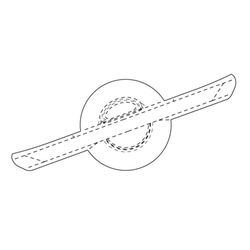
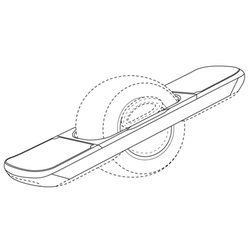
A siderail for a one-wheeled vehicle may include an elongate structural rail having a web extending from a first longitudinal end to a second longitudinal end. The rail is defined by four segments: a central segment defining a horizontal reference, a rear segment extending directly away from the central segment at an upward angle, a first forward segment extending directly away from the central segment at a downward angle, and a second forward segment extending directly away from the first forward segment at an upward angle.
09 - Scientific and electric apparatus and instruments
Goods & Services
Downloadable software in the nature of a mobile application for use in riding control and adjustment of regenerative braking and wheelie angle in the field of the electric bike industry
A self-propelled, one-wheeled vehicle may include a suspension system configured to dampen up and down motion of a board relative to the axle of a central wheel assembly when the vehicle encounters obstacles and bumps on a riding surface. Illustrative suspension systems include a shock absorber, a rocker, a pushrod, bell cranks, and/or a swingarm that couple the axle to the board. The suspension system may be disposed completely below a foot deck of the vehicle.
Footpad assemblies and foot support assemblies of the present disclosure include a foot engagement structure configured to be operatively coupled to the footpad of an electric vehicle. The foot engagement structure is configured to contact a rider's foot to prevent undesired movement of the rider's foot during use of the electric vehicle. In some examples, the foot engagement structure is operatively coupled to an insert secured to the footpad using a reusable fastener. For example, a recess may be defined in an upper surface of the footpad and the insert is disposed in the recess. In some examples, the foot engagement structure comprises a foot stop including a rigid body extending above the footpad and configured to abut a side portion of the rider's foot. The position and rotational orientation of the foot stop relative to the footpad is configured to be adjustable by a user.
Footpad assemblies of the present disclosure include a footpad configured to be coupled to a frame of an electric vehicle and a foot engagement structure coupled to the footpad. The foot engagement structure is configured to contact the rider's foot to prevent undesired movement of the rider's foot during use of the electric vehicle. The footpad includes a recess defined in an upper surface of the footpad and an insert is disposed in the recess and coupled to the footpad. The insert is operatively coupled to the foot engagement structure. The foot engagement structure may comprise a foot stop extending above the footpad and configured to abut a side portion of the rider's foot and/or a traction insert configured to contact a bottom of the user's foot to provide grip or traction. The position and rotational orientation of the foot stop relative to the footpad is configured to be adjustable by a user.
A control system for a tiltable vehicle may include a motor controller configured to respond to backward or reverse operation of the vehicle by hindering a responsiveness of the control system (e.g., proportionally) and/or eventually disengaging a drive motor of the vehicle. Accordingly, a user may intuitively and safely dismount the vehicle by selectively commanding reverse operation. In some examples, the backward direction may be user-defined.
B60L 15/20 - Methods, circuits or devices for controlling the propulsion of electrically-propelled vehicles, e.g. their traction-motor speed, to achieve a desired performanceAdaptation of control equipment on electrically-propelled vehicles for remote actuation from a stationary place, from alternative parts of the vehicle or from alternative vehicles of the same vehicle train for control of the vehicle or its driving motor to achieve a desired performance, e.g. speed, torque, programmed variation of speed
B60L 50/50 - Electric propulsion with power supplied within the vehicle using propulsion power supplied by batteries or fuel cells
B62K 11/00 - Motorcycles, engine-assisted cycles or motor scooters with one or two wheels
12.
VIBRATIONAL NOTIFICATION OF MOTOR CONDITIONS IN A SELF-BALANCING ELECTRIC VEHICLE
A method for vibrationally notifying a rider of a self-balancing electric vehicle may include: operating a self-balancing electric vehicle, receiving, at a motor controller of a self-balancing electric vehicle, a measured value corresponding to a first parameter of the self-balancing electric vehicle, and applying a first pattern of vibrational impulses to a motor of the self-balancing electric vehicle in response to the self-balancing electric vehicle satisfying a first operational threshold value.
A self-propelled, one-wheeled vehicle may include a board having two deck portions each having a concave front footpad configured to receive a foot of a rider, and a wheel assembly disposed between the deck portions. The concave front footpad has a rider detection sensor in the form of a membrane switch conforming to the shape of the footpad (e.g., facilitated by one or more slots formed in the membrane switch). A motor assembly drives the vehicle in response to board orientation and rider detection information.
A method for vibrationally notifying a rider of a self-balancing electric vehicle may include: operating a self-balancing electric vehicle, receiving, at a motor controller of a self-balancing electric vehicle, a measured value corresponding to a first parameter of the self-balancing electric vehicle, and applying a first pattern of vibrational impulses to a motor of the self-balancing electric vehicle in response to the self-balancing electric vehicle satisfying a first operational threshold value.
A siderail for a one-wheeled vehicle may include an elongate structural rail having a web extending from a first longitudinal end to a second longitudinal end. The rail is defined by four segments: a central segment defining a horizontal reference, a rear segment extending directly away from the central segment at an upward angle, a first forward segment extending directly away from the central segment at a downward angle, and a second forward segment extending directly away from the first forward segment at an upward angle.
Footpad assemblies of the present disclosure include a footpad configured to be coupled to a frame of an electric vehicle and a foot engagement structure coupled to the footpad. The foot engagement structure is configured to contact the rider's foot to prevent undesired movement of the rider's foot during use of the electric vehicle. The footpad includes a recess defined in an upper surface of the footpad and an insert is disposed in the recess and coupled to the footpad. The insert is operatively coupled to the foot engagement structure. The foot engagement structure may comprise a foot stop extending above the footpad and configured to abut a side portion of the rider's foot and/or a traction insert configured to contact a bottom of the user's foot to provide grip or traction. The position and rotational orientation of the foot stop relative to the footpad is configured to be adjustable by a user.
Fender assemblies are disclosed, each assembly including a frame and a fender. The frame has a first leg including a first coupling portion and a second leg including a first latch portion, and the frame is configured to be coupled to the vehicle with the first leg and the second leg on opposite sides of a wheel. The fender has a first end and a second end, the first end having a second coupling portion configured to releasably mate with the first coupling portion of the frame to form a manually releasable joint, the second end comprising a second latch portion configured to mate with the first latch portion of the frame to releasably secure the second end to the frame.
Fender assemblies (100) are disclosed, each assembly (100) including a frame (110) and a fender (108). The frame (110) has a first leg (112) including a first coupling portion (114) and a second leg (116) including a first latch portion (118), and the frame (110) is configured to be coupled to the vehicle (102) with the first leg (112) and the second leg (116) on opposite sides of a wheel (106). The fender (108) has a first end (120) and a second end (122), the first end (120) having a second coupling portion (124) configured to releasably mate with the first coupling portion (114) of the frame (110) to form a manually releasable joint (126), the second end (122) comprising a second latch portion(128) configured to mate with the first latch portion (118) of the frame (110) to releasably secure the second end (122) to the frame (110).
A self-propelled, one-wheeled vehicle may include a board having two deck portions each having a concave front footpad configured to receive a foot of a rider, and a wheel assembly disposed between the deck portions. The concave front footpad has a rider detection sensor in the form of a membrane switch conforming to the shape of the footpad (e.g., facilitated by one or more slots formed in the membrane switch). A motor assembly drives the vehicle in response to board orientation and rider detection information.
A self-propelled, one-wheeled vehicle may include a suspension system configured to dampen up and down motion of a board relative to the axle of a central wheel assembly when the vehicle encounters obstacles and bumps on a riding surface. Illustrative suspension systems include a shock absorber, a rocker, a pushrod, bell cranks, and/or a swingarm that couple the axle to the board. The suspension system may be disposed completely below a foot deck of the vehicle.
A one-wheeled vehicle may include a board including first and second deck portions each configured to receive a left or right foot of a rider oriented generally perpendicular to a direction of travel of a board, and a pair of side rails, each of which are coupled to the first and second deck portions at distal ends. A top surface of each side rail defines a generally concave shape, such that a plane connecting distal edges of the end portions of the side rail is spaced apart from the central portion of the side rail. In some examples, a bottom surface of each side rail also defines a generally concave-upward shape. In some examples, a bottom surface of each side rail includes a central cutout.
Fender assemblies are disclosed, each assembly including a frame and a fender. The frame has a first leg including a first coupling portion and a second leg including a first latch portion, and the frame is configured to be coupled to the vehicle with the first leg and the second leg on opposite sides of a wheel. The fender has a first end and a second end, the first end having a second coupling portion configured to releasably mate with the first coupling portion of the frame to form a manually releasable joint, the second end comprising a second latch portion configured to mate with the first latch portion of the frame to releasably secure the second end to the frame.
A one-wheeled vehicle may comprise a board including first and second deck portions each configured to receive a left or right foot of a rider oriented generally perpendicular to a direction of travel of a board, and a pair of side rails, each of which are coupled to the first and second deck portions at distal ends. A top surface of each side rail defines a generally concave shape, such that a plane connecting distal edges of the end portions of the side rail is spaced apart from the central portion of the side rail. In some examples, a bottom surface of each side rail also defines a generally concave-upward shape. In some examples, a bottom surface of each side rail includes a central cutout.
A self-propelled, one-wheeled vehicle may include a suspension system configured to dampen up and down motion of a board relative to the axle of a central wheel assembly when the vehicle encounters obstacles and bumps on a riding surface. Illustrative suspension systems include a shock absorber, a rocker, a pushrod, bell cranks, and/or a swingarm that couple the axle to the board. The suspension system may be disposed completely below a foot deck of the vehicle.
A self-propelled, one-wheeled vehicle may include a board having two deck portions each having a concave front footpad configured to receive a foot of a rider, and a wheel assembly disposed between the deck portions. The concave front footpad has a rider detection sensor in the form of a membrane switch conforming to the shape of the footpad (e.g., facilitated by one or more slots formed in the membrane switch). A motor assembly drives the vehicle in response to board orientation and rider detection information.
A self-stabilizing, one-wheeled electric skateboard may include improved features. In some examples, the vehicle includes a status indicator viewable through a slot formed in an upper surface of the board. In some examples, the vehicle includes a convertible carrying handle transitionable between stowed and deployed positions. In some examples, the vehicle includes an interchangeable fender and fender substitute that may be removably coupled to an upper surface of the board. In some examples, a motor controller of the vehicle may operate a field-oriented control (FOC) scheme configured to control the electric motor by manipulating a direct current aligned with a rotating rotor flux angle and a quadrature current defined at ninety degrees from the rotating rotor flux angle. In some examples, the motor controller may be configured to permit intuitive dismounting of the vehicle by tilting and/or moving the vehicle backward.
A control system for a tiltable vehicle may include a motor controller configured to respond to backward or reverse operation of the vehicle by hindering a responsiveness of the control system (e.g., proportionally) and/or eventually disengaging a drive motor of the vehicle. Accordingly, a user may intuitively and safely dismount the vehicle by selectively commanding reverse operation. In some examples, the backward direction may be user-defined.
B60L 15/20 - Methods, circuits or devices for controlling the propulsion of electrically-propelled vehicles, e.g. their traction-motor speed, to achieve a desired performanceAdaptation of control equipment on electrically-propelled vehicles for remote actuation from a stationary place, from alternative parts of the vehicle or from alternative vehicles of the same vehicle train for control of the vehicle or its driving motor to achieve a desired performance, e.g. speed, torque, programmed variation of speed
B60L 50/50 - Electric propulsion with power supplied within the vehicle using propulsion power supplied by batteries or fuel cells
B62K 11/00 - Motorcycles, engine-assisted cycles or motor scooters with one or two wheels
An electric vehicle includes a lateral self-stabilization system and may further include a fore-aft self-stabilization system. The lateral self-stabilization system may include a controller configured to cause an actuator to laterally tilt a frame of the vehicle based on sensed information relating to an orientation of the vehicle, or portion thereof, about a roll axis. The frame of the vehicle may include any suitable structure configured to be laterally tilted by the actuator relative to an axle of the vehicle. The fore-aft stabilization system may include a motor controller configured to drive a motor of the vehicle based on sensed information relating to a pitch angle of the vehicle. In some examples, the vehicle is a robotic vehicle.
B62D 61/00 - Motor vehicles or trailers, characterised by the arrangement or number of wheels, not otherwise provided for, e.g. four wheels in diamond pattern
B60K 7/00 - Disposition of motor in, or adjacent to, traction wheel
B60G 13/00 - Resilient suspensions characterised by arrangement, location, or type of vibration-dampers
A63C 17/08 - Roller skatesSkate-boards with wheels arranged otherwise than in two pairs single-track type single-wheel type
A self-propelled, one-wheeled vehicle may include a board having two deck portions each having a concave front footpad configured to receive a foot of a rider, and a wheel assembly disposed between the deck portions. The concave front footpad has a rider detection sensor in the form of a membrane switch conforming to the shape of the footpad (e.g., facilitated by one or more slots formed in the membrane switch). A motor assembly drives the vehicle in response to board orientation and rider detection information. The vehicle may have a secondary battery chargeable via a three-pin charging port including an input pin, a ground pin, and an identification pin configured to receive an expected identification signal from an external charging circuit.
A63C 17/12 - Roller skatesSkate-boards with driving mechanisms
B60L 15/20 - Methods, circuits or devices for controlling the propulsion of electrically-propelled vehicles, e.g. their traction-motor speed, to achieve a desired performanceAdaptation of control equipment on electrically-propelled vehicles for remote actuation from a stationary place, from alternative parts of the vehicle or from alternative vehicles of the same vehicle train for control of the vehicle or its driving motor to achieve a desired performance, e.g. speed, torque, programmed variation of speed
B60L 50/60 - Electric propulsion with power supplied within the vehicle using propulsion power supplied by batteries or fuel cells using power supplied by batteries
B60L 53/16 - Connectors, e.g. plugs or sockets, specially adapted for charging electric vehicles
B60L 58/10 - Methods or circuit arrangements for monitoring or controlling batteries or fuel cells, specially adapted for electric vehicles for monitoring or controlling batteries
B62K 11/00 - Motorcycles, engine-assisted cycles or motor scooters with one or two wheels
H02J 7/00 - Circuit arrangements for charging or depolarising batteries or for supplying loads from batteries
A self-propelled, one-wheeled vehicle may include a board having two deck portions each having a concave front footpad configured to receive a foot of a rider, and a wheel assembly disposed between the deck portions. The concave front footpad has a rider detection sensor in the form of a membrane switch conforming to the shape of the footpad (e.g., facilitated by one or more slots formed in the membrane switch). A motor assembly drives the vehicle in response to board orientation and rider detection information. The vehicle may have a secondary battery chargeable via a three-pin charging port including an input pin, a ground pin, and an identification pin configured to receive an expected identification signal from an external charging circuit.
A63C 17/12 - Roller skatesSkate-boards with driving mechanisms
B60L 15/20 - Methods, circuits or devices for controlling the propulsion of electrically-propelled vehicles, e.g. their traction-motor speed, to achieve a desired performanceAdaptation of control equipment on electrically-propelled vehicles for remote actuation from a stationary place, from alternative parts of the vehicle or from alternative vehicles of the same vehicle train for control of the vehicle or its driving motor to achieve a desired performance, e.g. speed, torque, programmed variation of speed
B60L 50/60 - Electric propulsion with power supplied within the vehicle using propulsion power supplied by batteries or fuel cells using power supplied by batteries
B60L 53/16 - Connectors, e.g. plugs or sockets, specially adapted for charging electric vehicles
B60L 53/65 - Monitoring or controlling charging stations involving identification of vehicles or their battery types
B60L 58/10 - Methods or circuit arrangements for monitoring or controlling batteries or fuel cells, specially adapted for electric vehicles for monitoring or controlling batteries
B62K 11/00 - Motorcycles, engine-assisted cycles or motor scooters with one or two wheels
H02J 7/00 - Circuit arrangements for charging or depolarising batteries or for supplying loads from batteries
A self-propelled, one-wheeled vehicle may include a board having two deck portions each having a concave front footpad configured to receive a foot of a rider, and a wheel assembly disposed between the deck portions. The concave front footpad has a rider detection sensor in the form of a membrane switch conforming to the shape of the footpad (e.g., facilitated by one or more slots formed in the membrane switch). A motor assembly drives the vehicle in response to board orientation and rider detection information.
A self-propelled, one-wheeled vehicle may include a board having two deck portions each having a concave front footpad configured to receive a foot of a rider, and a wheel assembly disposed between the deck portions. The concave front footpad has a rider detection sensor in the form of a membrane switch conforming to the shape of the footpad (e.g., facilitated by one or more slots formed in the membrane switch). A motor assembly drives the vehicle in response to board orientation and rider detection information.
A self-propelled, one-wheeled vehicle includes a suspension system configured to dampen up-and-down motion of a board relative to the axle of a central wheel assembly when the vehicle encounters obstacles (e.g., bumps) on a riding surface. Illustrative suspension systems include a shock absorber and a swingarm that couple the axle to the board. The suspension system may be disposed completely below a foot deck of the vehicle.
Fender assemblies are disclosed, each including a rectangular frame defining a central aperture. The perimeter of the central aperture may have a rounded-rectangle shape. A fender arch in the form of an arcuate sheet, e.g., of carbon fiber (CF), terminates on either end at respective first and second flanges extending outward to form a planar base. The arcuate sheet extends through the central aperture to reach above a top side of the frame and the flanges abut a bottom side of the frame. A mud guard is coupled to the rectangular frame through the first flange of the arcuate sheet, such that the mud guard extends from the first flange away from the second side of the frame. The frame and mud guard may be made of plastic, and may be configured to absorb assembly forces to avoid damaging the CF fender arch.
A self-propelled, one-wheeled vehicle includes a suspension system configured to dampen up-and-down motion of a board relative to the axle of a central wheel assembly when the vehicle encounters obstacles (e.g., bumps) on a riding surface. Illustrative suspension systems include a shock absorber and a swingarm that couple the axle to the board. The suspension system may be disposed completely below a foot deck of the vehicle.
Fender assemblies are disclosed, each including a rectangular frame defining a central aperture. The perimeter of the central aperture may have a rounded-rectangle shape. A fender arch in the form of an arcuate sheet, e.g., of carbon fiber (CF), terminates on either end at respective first and second flanges extending outward to form a planar base. The arcuate sheet extends through the central aperture to reach above a top side of the frame and the flanges abut a bottom side of the frame. A mud guard is coupled to the rectangular frame through the first flange of the arcuate sheet, such that the mud guard extends from the first flange away from the second side of the frame. The frame and mud guard may be made of plastic, and may be configured to absorb assembly forces to avoid damaging the CF fender arch.
A three-wheeled vehicle may include one rear wheel and two front wheels coupled to a tiltable chassis, such that tilting of the chassis causes a corresponding tilting of the three wheels. The tiltable chassis includes a tiltable body coupled to a non-tilting frame by a pair of rotatable joints, such that the tiltable body is configured to rotate relative to the frame. A fore-and-aft connecting beam of the tiltable body extends beneath the frame to accommodate a battery compartment or other storage on top of the frame. A front tower extends upward from a front end of the connecting beam, above the frame, to couple to a tilt linkage and seat post of the vehicle. A rear tower extends upward from a rear end of the connecting beam to retain the rear wheel.
B60G 21/00 - Interconnection systems for two or more resiliently-suspended wheels, e.g. for stabilising a vehicle body with respect to acceleration, deceleration or centrifugal forces
B62D 61/06 - Motor vehicles or trailers, characterised by the arrangement or number of wheels, not otherwise provided for, e.g. four wheels in diamond pattern with only three wheels
12 - Land, air and water vehicles; parts of land vehicles
Goods & Services
Self-propelled electric vehicles; vehicles, namely,
electronically motorized skateboards; land vehicle parts,
namely, electronically motorized skateboards parts in the
nature of rail guards; vehicle bumpers.
12 - Land, air and water vehicles; parts of land vehicles
Goods & Services
(1) Self-propelled electric vehicles, namely electric skateboards; vehicles, namely, electronically motorized skateboards; land vehicle parts, namely, electronically motorized skateboards parts in the nature of rail guards; vehicle bumpers.
A self-propelled, one-wheeled vehicle may include a suspension system configured to dampen up and down motion of a board relative to the axle of a central wheel assembly when the vehicle encounters obstacles and bumps on a riding surface. Illustrative suspension systems include a shock absorber, a rocker, a pushrod, bell cranks, and/or a swingarm that couple the axle to the board. The suspension system may be disposed completely below a foot deck of the vehicle.
A self-propelled, one-wheeled vehicle may include a board having two deck portions each having a concave front footpad configured to receive a foot of a rider, and a wheel assembly disposed between the deck portions. The concave front footpad has a rider detection sensor in the form of a membrane switch conforming to the shape of the footpad (e.g., facilitated by one or more slots formed in the membrane switch). A motor assembly drives the vehicle in response to board orientation and rider detection information. The vehicle may have a secondary battery chargeable via a three-pin charging port including an input pin, a ground pin, and an identification pin configured to receive an expected identification signal from an external charging circuit.
A63C 17/12 - Roller skatesSkate-boards with driving mechanisms
B60L 53/65 - Monitoring or controlling charging stations involving identification of vehicles or their battery types
B60L 15/20 - Methods, circuits or devices for controlling the propulsion of electrically-propelled vehicles, e.g. their traction-motor speed, to achieve a desired performanceAdaptation of control equipment on electrically-propelled vehicles for remote actuation from a stationary place, from alternative parts of the vehicle or from alternative vehicles of the same vehicle train for control of the vehicle or its driving motor to achieve a desired performance, e.g. speed, torque, programmed variation of speed
B60L 50/60 - Electric propulsion with power supplied within the vehicle using propulsion power supplied by batteries or fuel cells using power supplied by batteries
B60L 58/10 - Methods or circuit arrangements for monitoring or controlling batteries or fuel cells, specially adapted for electric vehicles for monitoring or controlling batteries
A control system for a tiltable vehicle may include a motor controller configured to respond to backward or reverse operation of the vehicle by hindering a responsiveness of the control system (e.g., proportionally) and/or eventually disengaging a drive motor of the vehicle. Accordingly, a user may intuitively and safely dismount the vehicle by selectively commanding reverse operation. In some examples, the backward direction may be user-defined.
B60L 15/20 - Methods, circuits or devices for controlling the propulsion of electrically-propelled vehicles, e.g. their traction-motor speed, to achieve a desired performanceAdaptation of control equipment on electrically-propelled vehicles for remote actuation from a stationary place, from alternative parts of the vehicle or from alternative vehicles of the same vehicle train for control of the vehicle or its driving motor to achieve a desired performance, e.g. speed, torque, programmed variation of speed
B62K 11/00 - Motorcycles, engine-assisted cycles or motor scooters with one or two wheels
B60L 50/50 - Electric propulsion with power supplied within the vehicle using propulsion power supplied by batteries or fuel cells
A self-propelled, one-wheeled vehicle may include a suspension system configured to dampen up and down motion of a board relative to the axle of a central wheel assembly when the vehicle encounters obstacles and bumps on a riding surface. Illustrative suspension systems include a shock absorber, a rocker, a pushrod, bell cranks, and/or a swingarm that couple the axle to the board. The suspension system may be disposed completely below a foot deck of the vehicle.
An electric weight sensing skateboard using one or more strain gauge systems to detect rider-induced strain on one or both trucks, an inertial sensor to detect accelerations and balance position, and wheel speed sensors. Throttle is controlled by rider position, for example, lean forward to increase speed, lean back to slow down. Several drive methods include a driver position detection velocity setpoint control, torque setpoint control, and direct velocity/torque control. A throttle remote is note required. Rider weight activates the motors.
B60L 15/20 - Methods, circuits or devices for controlling the propulsion of electrically-propelled vehicles, e.g. their traction-motor speed, to achieve a desired performanceAdaptation of control equipment on electrically-propelled vehicles for remote actuation from a stationary place, from alternative parts of the vehicle or from alternative vehicles of the same vehicle train for control of the vehicle or its driving motor to achieve a desired performance, e.g. speed, torque, programmed variation of speed
G01L 5/22 - Apparatus for, or methods of, measuring force, work, mechanical power, or torque, specially adapted for specific purposes for measuring the force applied to control members, e.g. control members of vehicles, triggers
B60L 50/60 - Electric propulsion with power supplied within the vehicle using propulsion power supplied by batteries or fuel cells using power supplied by batteries
A self-propelled, one-wheeled vehicle may include a board having two deck portions each having a concave front footpad configured to receive a foot of a rider, and a wheel assembly disposed between the deck portions. The concave front footpad has a rider detection sensor in the form of a membrane switch conforming to the shape of the footpad (e.g., facilitated by one or more slots formed in the membrane switch). A motor assembly drives the vehicle in response to board orientation and rider detection information.
12 - Land, air and water vehicles; parts of land vehicles
Goods & Services
Self-propelled electric vehicle; vehicles, namely, electronically motorized skateboards; land vehicle parts, namely, electronically motorized skateboards parts in the nature of rail guards; vehicle bumpers
A self-propelled, one-wheeled vehicle may include a suspension system configured to dampen up and down motion of a board relative to the axle of a central wheel assembly when the vehicle encounters obstacles and bumps on a riding surface. Illustrative suspension systems include a shock absorber, a rocker, a pushrod, bell cranks, and/or a swingarm that couple the axle to the board. The suspension system may be disposed completely below a foot deck of the vehicle.
09 - Scientific and electric apparatus and instruments
Goods & Services
Downloadable software in the nature of a mobile application for mobile phones and handheld computers for use in calibrating and changing the ride settings of an electric skateboard
A self-stabilizing, one-wheeled electric skateboard may include improved features. In some examples, the vehicle includes a status indicator viewable through a slot formed in an upper surface of the board. In some examples, the vehicle includes a convertible carrying handle transitionable between stowed and deployed positions. In some examples, the vehicle includes an interchangeable fender and fender substitute that may be removably coupled to an upper surface of the board. In some examples, a motor controller of the vehicle may operate a field-oriented control (FOC) scheme configured to control the electric motor by manipulating a direct current aligned with a rotating rotor flux angle and a quadrature current defined at ninety degrees from the rotating rotor flux angle. In some examples, the motor controller may be configured to permit intuitive dismounting of the vehicle by tilting and/or moving the vehicle backward.
12 - Land, air and water vehicles; parts of land vehicles
Goods & Services
(1) Self-propelled electric vehicle; vehicles, namely, electronically motorized skateboards; motors for electronically motorized skateboards; electric motors for land vehicles; electric motors for electrically powered motor vehicles; braking systems for motor vehicles and parts thereof
09 - Scientific and electric apparatus and instruments
12 - Land, air and water vehicles; parts of land vehicles
Goods & Services
(1) Chargers for electric batteries, namely, chargers for batteries for electronically motorized skateboards and self-propelled electrically powered motor vehicles; battery chargers for electronically motorized skateboards and self-propelled electric vehicles.
(2) Self-propelled electric vehicle; vehicles, namely, electronically motorized skateboards; land vehicle parts, namely, fenders and fender deletes; footpads for electronically motorized skateboards; vehicle bumpers; carrying handles for electronically motorized skateboards and self-propelled electric vehicles.
09 - Scientific and electric apparatus and instruments
12 - Land, air and water vehicles; parts of land vehicles
Goods & Services
(1) Chargers for electric batteries, namely, chargers for batteries for electronically motorized skateboards and self-propelled electrically powered motor vehicles; battery chargers for electronically motorized skateboards and self-propelled electric vehicles.
(2) Self-propelled electric vehicle; vehicles, namely, electronically motorized skateboards; land vehicle parts, namely, fenders and fender deletes; footpads for electronically motorized skateboards; vehicle bumpers; carrying handles for electronically motorized skateboards and self-propelled electric vehicles.
12 - Land, air and water vehicles; parts of land vehicles
Goods & Services
(1) Vehicles, namely, electronically motorized skateboards; motors for electronically motorized skateboards; electric motors for land vehicles; electric motors for electric vehicles.
09 - Scientific and electric apparatus and instruments
12 - Land, air and water vehicles; parts of land vehicles
25 - Clothing; footwear; headgear
Goods & Services
(1) Chargers for electric batteries, namely, chargers for batteries for electronically motorized skateboards and self-propelled electrically powered motor vehicles; battery chargers for electronically motorized skateboards and self-propelled electric vehicles; Bags specially adapted to carry chargers for electric batteries and battery chargers for electronically motorized skateboards and self-propelled electric vehicles; Protective sports helmets
(2) Vehicles, namely, electronically motorized skateboards; Land vehicle parts, namely, fenders; Bags specially adapted to carry electronically motorized skateboards and self-propelled electrically powered motor vehicles; footpads for electronically motorized skateboards; Vehicle bumpers; metal stands for holding stationary electronically motorized skateboards and self-propelled electric vehicles in an upright position; Holders specially adapted for holding electronically motorized skateboards and self-propelled electrically powered motor vehicles.
(3) Hats; Beanies; Socks; T-shirts; Shirts
09 - Scientific and electric apparatus and instruments
Goods & Services
(1) Computer application software for mobile phones and handheld computers, namely, software for use in defining and describing the ride characteristics of an electric skateboard
A self-stabilizing, one-wheeled electric skateboard may include improved features. In some examples, the vehicle includes a status indicator viewable through a slot formed in an upper surface of the board. In some examples, the vehicle includes a convertible carrying handle transitionable between stowed and deployed positions. In some examples, the vehicle includes an interchangeable fender and fender substitute that may be removably coupled to an upper surface of the board. In some examples, a motor controller of the vehicle may operate a field-oriented control (FOC) scheme configured to control the electric motor by manipulating a direct current aligned with a rotating rotor flux angle and a quadrature current defined at ninety degrees from the rotating rotor flux angle. In some examples, the motor controller may be configured to permit intuitive dismounting of the vehicle by tilting and/or moving the vehicle backward.
A self-stabilizing, one-wheeled electric skateboard may include improved features. In some examples, the vehicle includes a status indicator viewable through a slot formed in an upper surface of the board. In some examples, the vehicle includes a convertible carrying handle transitionable between stowed and deployed positions. In some examples, the vehicle includes an interchangeable fender and fender substitute that may be removably coupled to an upper surface of the board. In some examples, a motor controller of the vehicle may operate a field-oriented control (FOC) scheme configured to control the electric motor by manipulating a direct current aligned with a rotating rotor flux angle and a quadrature current defined at ninety degrees from the rotating rotor flux angle. In some examples, the motor controller may be configured to permit intuitive dismounting of the vehicle by tilting and/or moving the vehicle backward.
An electric vehicle includes a lateral self-stabilization system and may further include a fore-aft self-stabilization system. The lateral self-stabilization system may include a controller configured to cause an actuator to laterally tilt a frame of the vehicle based on sensed information relating to an orientation of the vehicle, or portion thereof, about a roll axis. The frame of the vehicle may include any suitable structure configured to be laterally tilted by the actuator relative to an axle of the vehicle. The fore-aft stabilization system may include a motor controller configured to drive a motor of the vehicle based on sensed information relating to a pitch angle of the vehicle. In some examples, the vehicle is a robotic vehicle.
B60L 15/20 - Methods, circuits or devices for controlling the propulsion of electrically-propelled vehicles, e.g. their traction-motor speed, to achieve a desired performanceAdaptation of control equipment on electrically-propelled vehicles for remote actuation from a stationary place, from alternative parts of the vehicle or from alternative vehicles of the same vehicle train for control of the vehicle or its driving motor to achieve a desired performance, e.g. speed, torque, programmed variation of speed
B60K 7/00 - Disposition of motor in, or adjacent to, traction wheel
B62K 11/00 - Motorcycles, engine-assisted cycles or motor scooters with one or two wheels