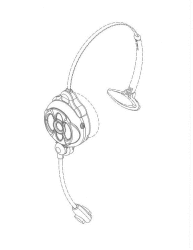
09 - Scientific and electric apparatus and instruments
Goods & Services
Wireless and cabled intercom systems and components thereof, namely, intercom systems and components comprised of base stations, beltpacs, earphones, headphones, headsets, routers, batteries, microphones and speakers for use with drive-thrus, retail stores, convenience stores, truck stops and professional audio marketplaces; speed of service timers and components thereof for use with drive-thrus and drive-ups and downloadable computer software for communicating with speed of service timers; people and vehicle magnetic object detectors, ultrasonic loop detectors, and video detectors for use in detecting people and vehicles for determining the speed and number of people or vehicles proceeding through drive-thrus or within restaurants, stores, casinos, or malls; radio pagers; radio transmitters; downloadable computer software for communicating with, or paging, wireless devices
09 - Scientific and electric apparatus and instruments
Goods & Services
Wireless and cabled intercom systems and components thereof, namely, intercom systems and components comprised of base stations, beltpacs, earphones, headphones, headsets, routers, batteries, microphones and speakers for use with drive-thrus, retail stores, convenience stores, truck stops and professional audio marketplaces; speed of service timers and components thereof for use with drive-thrus and drive-ups and downloadable computer software for communicating with speed of service timers; people and vehicle magnetic object detectors, ultrasonic loop detectors, and video detectors for use in detecting people and vehicles for determining the speed and number of people or vehicles proceeding through drive-thrus or within restaurants, stores, casinos, or malls; radio pagers; radio transmitters; downloadable computer software for communicating with, or paging, wireless devices
3.
Systems and methods for detection status of intercom termination
Systems and methods for detecting detect termination status in an audio communication system, wherein termination status indicates whether exactly one termination circuit is part of the audio communication system, are disclosed. Exemplary implementations may: accept an input voltage, by a voltage-controlled current source that includes and drives a resistive load; generate an AC voltage used as an input voltage for the current source; connect a first set of one or more filters to the output of the current source that generate a first analog output signal; connect a second set of one or more filters to the resistive load that generate a second analog output signal; determine a ratio of the first and second analog output signals and use it to determine the termination status.
09 - Scientific and electric apparatus and instruments
Goods & Services
Electronic timers; speed of service timer used in quick-service restaurants and drive-thru applications, namely, vehicle detectors including monitoring cameras, and the recorded operational software and components thereof
5.
Systems and methods for crosstalk reduction for audio communications
Systems and methods for operating a multi-channel intercom system for audio communications between users, with reduced crosstalk, are disclosed. Exemplary implementations may: receive, by a first user station, a modulation carrier signal; capture a first audio signal from a first user, wherein the first audio signal has a first phase; at a rate based on the modulation carrier signal, invert the first phase of the first audio signal to generate a phase-flipped audio signal; transfer the phase-flipped audio signal to a second user station; at a second rate based on the modulation carrier signal, invert a phase of the phase-flipped audio signal to generate an intermediate audio signal; and present a second audio signal based on the intermediate audio signal to the second user.
H04M 1/60 - Substation equipment, e.g. for use by subscribers including speech amplifiers
H04M 9/00 - Arrangements for interconnection not involving centralised switching
H04M 9/08 - Two-way loud-speaking telephone systems with means for conditioning the signal, e.g. for suppressing echoes for one or both directions of traffic
Systems and methods for assigning voice communication channels used by a crew of employees using communication devices are disclosed. Exemplary implementations may: electronically store information, wherein the information represents associations of individual voice communication channels with one or more communication groups; receive user input that identifies employees, automatically determine sets of communication channel assignments per communication device, between communication channels and subsets of communication groups; configure communication devices according to the determined assignments; and facilitate packet-based communication, using the communication channels, between the communication devices.
Systems and methods for facilitating wireless intercom in a local communications network are disclosed. Exemplary implementations may: generate and transmit a first broadcast packet and a second broadcast packet to a set of end-user communication devices; receive a first device-specific packet, on a first channel by a first central antenna and during a first uplink time period; receive a second device-specific packet, on the first channel by the first central antenna and during a second uplink time period; receive the first device-specific packet, on a second channel by a second central antenna and during a third uplink time period; receive the second device-specific packet, on the second channel by the second central antenna and during a fourth uplink time period; generate a third broadcast packet that includes packetized downlink information; and transmit the third broadcast packet to the set of end-user communication devices.
Systems and methods for facilitating intercom communication for one or more quick-service restaurant drive-throughs are disclosed. Exemplary implementations may: capture sound from a customer placing an order; generate order information signals that represent the captured sound; encode signals to form order data packets; transmit the order data packets to a base station through a single pair of wires that is also used to provide power; decode information from the order data packets; and generate order sound based on the decoded information, such that the generated order sound is audible to a staff member of the quick service restaurant through a headset.
G10L 19/00 - Speech or audio signal analysis-synthesis techniques for redundancy reduction, e.g. in vocodersCoding or decoding of speech or audio signals, using source filter models or psychoacoustic analysis
Systems and methods for facilitating secure localized communications in a local communications network are disclosed. Exemplary implementations may: detect proximity of portable communication devices; pair a central communication hub with a first portable communication device and pair the central communication hub with a second portable communication device; receive instructions, from a first client computing platform that is associated with a first supervisory user; generate the one or more messages for transmission to the one or more portable communication devices; and transmit the one or more messages to the one or more portable communication devices via the secondary wireless communication links such that a first message is transmitted to the first portable communication device.
H04W 4/80 - Services using short range communication, e.g. near-field communication [NFC], radio-frequency identification [RFID] or low energy communication
Systems and methods for providing headset/ear bud voice control to crew members in a quick-service restaurant are disclosed. Exemplary implementations may: transmit transmission signals from a headset to the base station, receive reception signals by the headset from the base station; capture audio information from a first crew member, generate sound based on the received reception signals, generate the transmission signals to form a headset-specific uplink packet based on the captured audio information; generate semantic information based on the headset-specific uplink packet, wherein the semantic information includes one or more individual words; determine one or more commands that modify operation of the communication system, based on the semantic information, and facilitate execution of the one or more commands to control and/or modify the operation of the communication system.
Systems and methods for detecting detect termination status in an audio communication system, wherein termination status indicates whether exactly one termination circuit is part of the audio communication system, are disclosed. Exemplary implementations may: accept an input voltage, by a voltage-controlled current source that includes and drives a resistive load; generate an AC voltage used as an input voltage for the current source; connect a first set of one or more filters to the output of the current source that generate a first analog output signal; connect a second set of one or more filters to the resistive load that generate a second analog output signal; determine a ratio of the first and second analog output signals and use it to determine the termination status.
Systems and methods for operating a multi-channel intercom system for audio communications between users, with reduced crosstalk, are disclosed. Exemplary implementations may: receive, by a first user station, a modulation carrier signal; capture a first audio signal from a first user, wherein the first audio signal has a first phase; at a rate based on the modulation carrier signal, invert the first phase of the first audio signal to generate a phase-flipped audio signal; transfer the phase-flipped audio signal to a second user station; at a second rate based on the modulation carrier signal, invert a phase of the phase-flipped audio signal to generate an intermediate audio signal; and present a second audio signal based on the intermediate audio signal to the second user.
H04M 1/60 - Substation equipment, e.g. for use by subscribers including speech amplifiers
H04M 9/00 - Arrangements for interconnection not involving centralised switching
H04M 9/08 - Two-way loud-speaking telephone systems with means for conditioning the signal, e.g. for suppressing echoes for one or both directions of traffic
H04S 3/00 - Systems employing more than two channels, e.g. quadraphonic
Systems and methods for assigning voice communication channels used by a crew of employees using communication devices are disclosed. Exemplary implementations may: electronically store information, wherein the information represents associations of individual voice communication channels with one or more communication groups; receive user input that identifies employees, automatically determine sets of communication channel assignments per communication device, between communication channels and subsets of communication groups; configure communication devices according to the determined assignments; and facilitate packet-based communication, using the communication channels, between the communication devices.
Systems and methods for facilitating wireless intercom in a local communications network are disclosed. Exemplary implementations may: generate and transmit a first broadcast packet and a second broadcast packet to a set of end-user communication devices; receive a first device-specific packet, on a first channel by a first central antenna and during a first uplink time period; receive a second device-specific packet, on the first channel by the first central antenna and during a second uplink time period; receive the first device-specific packet, on a second channel by a second central antenna and during a third uplink time period; receive the second device-specific packet, on the second channel by the second central antenna and during a fourth uplink time period; generate a third broadcast packet that includes packetized downlink information; and transmit the third broadcast packet to the set of end-user communication devices.
Systems and methods for facilitating intercom communication for one or more quick-service restaurant drive-throughs are disclosed. Exemplary implementations may: capture sound from a customer placing an order; generate order information signals that represent the captured sound; encode signals to form order data packets; transmit the order data packets to a base station through a single pair of wires that is also used to provide power; decode information from the order data packets; and generate order sound based on the decoded information, such that the generated order sound is audible to a staff member of the quick service restaurant through a headset.
G10L 19/00 - Speech or audio signal analysis-synthesis techniques for redundancy reduction, e.g. in vocodersCoding or decoding of speech or audio signals, using source filter models or psychoacoustic analysis
Systems and methods for assigning voice communication channels used by a crew of employees using communication devices are disclosed. Exemplary implementations may: electronically store information, wherein the information represents associations of individual voice communication channels with one or more communication groups; receive user input that identifies employees, automatically determine sets of communication channel assignments per communication device, between communication channels and subsets of communication groups; configure communication devices according to the determined assignments; and facilitate packet-based communication, using the communication channels, between the communication devices.
09 - Scientific and electric apparatus and instruments
Goods & Services
User interfaces, namely, touchscreens for wireless electronic communication networks devices; wireless transmitters for sending out signals to stationary call devices; telecommunications transmitters; transmitters of electronic signals; wireless transmitters; signal processing nodes, namely, repeater nodes; nodes, namely, wireless routers manufactured and designed for providing wireless network telecommunications connectivity; multifunctional smartwatches incorporating recorded software for displaying text, data, and digital files; wireless communication devices for data transmission in the form of a cuff incorporating recorded software for displaying text, data, and digital files; multifunctional smartwatches incorporating recorded software for connecting to other computer software applications to notify users of incoming alerts, messages, and reminders; wireless communication devices for data transmission in the form of a cuff incorporating recorded software for connecting to other computer software applications to notify users of incoming alerts, messages, and reminders; multifunctional electronic devices, namely, smartphones, tablet computers, and computer devices incorporating recorded software for displaying text, data, and digital files; wearable portable electronic devices, namely, smartwatches incorporating recorded software for transmitting and receiving text, data, and digital files; wireless communication devices for data transmission in the form of a cuff incorporating recorded software for transmitting and receiving text, data, and digital files; handheld smartphone devices incorporating recorded software for transmitting and receiving text, data, and digital files; smartwatches incorporating recorded software for transferring data across wireless electronic communication networks; wireless communication devices for data transmission in the form of a cuff wristband incorporating recorded software for transferring data across wireless electronic communication networks; smartwatches incorporating recorded software for sending alerts, messages, and reminders and for transmitting and receiving text, data, and digital files; wireless communication devices for data transmission in the form of a cuff incorporating recorded software for sending alerts, messages, and reminders and for transmitting and receiving text, data, and digital files; wrist-wearable smartwatches incorporating recorded software for displaying, tracking, monitoring, and transmitting text, data, and digital files; wireless communication devices for data transmission in the form of a cuff incorporating recorded software for displaying, tracking, monitoring, and transmitting text, data, and digital files; call buttons, namely, call bells designed to allow users to communicate with others; electrical monitoring system comprised primarily of call bells for requesting service; call buttons in the nature of call bells designed to allow users to communicate with others
18.
Systems and methods for providing headset voice control to employees in quick-service restaurants
Systems and methods for providing headset/ear bud voice control to crew members in a quick-service restaurant are disclosed. Exemplary implementations may: transmit transmission signals from a headset to the base station, receive reception signals by the headset from the base station; capture audio information from a first crew member, generate sound based on the received reception signals, generate the transmission signals to form a headset-specific uplink packet based on the captured audio information; generate semantic information based on the headset-specific uplink packet, wherein the semantic information includes one or more individual words; determine one or more commands that modify operation of the communication system, based on the semantic information, and facilitate execution of the one or more commands to control and/or modify the operation of the communication system.
Systems and methods for managing voice communication channels used by a group of people are disclosed. Exemplary implementations may: electronically store information, wherein the information represents associations of individual voice communication channels with one or more communication groups, wherein individual ones of the one or more communication groups are specific to one or more roles of the people; receive device-specific packets from end-user communication devices associated with people, wherein the packets include packetized uplink information based on audio information captured by the communication devices, wherein individual packets are targeted to individual communication groups; generate and transmit downlink packets that include packetized downlink information that is organized in a set of broadcast channels for audio information that was targeted to specific communication groups.
Systems and methods for facilitating secure localized communications in a local communications network are disclosed. Exemplary implementations may: detect proximity of portable communication devices; pair a central communication hub with a first portable communication device and pair the central communication hub with a second portable communication device; receive instructions, from a first client computing platform that is associated with a first supervisory user; generate the one or more messages for transmission to the one or more portable communication devices; and transmit the one or more messages to the one or more portable communication devices via the secondary wireless communication links such that a first message is transmitted to the first portable communication device.
H04W 4/80 - Services using short range communication, e.g. near-field communication [NFC], radio-frequency identification [RFID] or low energy communication
09 - Scientific and electric apparatus and instruments
Goods & Services
User interfaces, namely, touchscreens for wireless electronic communication networks devices; wireless transmitters for sending out signals to stationary call devices; telecommunications transmitters; transmitters of electronic signals; wireless transmitters; signal processing nodes, namely, repeater nodes; nodes, namely, wireless routers manufactured and designed for providing wireless network telecommunications connectivity; multifunctional smartwatches incorporating recorded software for displaying text, data, and digital files; wireless communication devices for data transmission in the form of a cuff incorporating recorded software for displaying text, data, and digital files; multifunctional smartwatches incorporating recorded software for connecting to other computer software applications to notify users of incoming alerts, messages, and reminders; wireless communication devices for data transmission in the form of a cuff incorporating recorded software for connecting to other computer software applications to notify users of incoming alerts, messages, and reminders; multifunctional electronic devices, namely, handheld smartphones, handheld tablet computers, and handheld computer devices incorporating recorded software for displaying text, data, and digital files; wearable portable electronic devices, namely, smartwatches incorporating recorded software for transmitting and receiving text, data, and digital files; wireless communication devices for data transmission in the form of a cuff incorporating recorded software for transmitting and receiving text, data, and digital files; handheld smartphone devices incorporating recorded software for transmitting and receiving text, data, and digital files; smartwatches incorporating recorded software for transferring data across wireless electronic communication networks; wireless communication devices for data transmission in the form of a cuff wristband incorporating recorded software for transferring data across wireless electronic communication networks; smartwatches incorporating recorded software for sending alerts, messages, and reminders and for transmitting and receiving text, data, and digital files; wireless communication devices for data transmission in the form of a cuff incorporating recorded software for sending alerts, messages, and reminders and for transmitting and receiving text, data, and digital files; wrist-wearable smartwatches incorporating recorded software for displaying, tracking, monitoring, and transmitting text, data, and digital files; wireless communication devices for data transmission in the form of a cuff incorporating recorded software for displaying, tracking, monitoring, and transmitting text, data, and digital files; call buttons, namely, call bells designed to allow users to communicate with others; electrical monitoring system comprised primarily of call bells for requesting service; call buttons in the nature of call bells designed to allow users to communicate with others
22.
Systems and methods for providing headset voice control to employees in quick-service restaurants
Systems and methods for providing headset/ear bud voice control to crew members in a quick-service restaurant are disclosed. Exemplary implementations may: transmit transmission signals from a headset to the base station, receive reception signals by the headset from the base station; capture audio information from a first crew member, generate sound based on the received reception signals, generate the transmission signals to form a headset-specific uplink packet based on the captured audio information; generate semantic information based on the headset-specific uplink packet, wherein the semantic information includes one or more individual words; determine one or more commands that modify operation of the communication system, based on the semantic information, and facilitate execution of the one or more commands to control and/or modify the operation of the communication system.
Systems and methods for assigning voice communication channels used by a crew of employees using communication devices are disclosed. Exemplary implementations may: electronically store information, wherein the information represents associations of individual voice communication channels with one or more communication groups; receive user input that identifies employees, automatically determine sets of communication channel assignments per communication device, between communication channels and subsets of communication groups; configure communication devices according to the determined assignments; and facilitate packet-based communication, using the communication channels, between the communication devices.
Systems and methods for managing voice communication channels used by a group of people are disclosed. Exemplary implementations may: electronically store information, wherein the information represents associations of individual voice communication channels with one or more communication groups, wherein individual ones of the one or more communication groups are specific to one or more roles of the people; receive device-specific packets from end-user communication devices associated with people, wherein the packets include packetized uplink information based on audio information captured by the communication devices, wherein individual packets are targeted to individual communication groups; generate and transmit downlink packets that include packetized downlink information that is organized in a set of broadcast channels for audio information that was targeted to specific communication groups.
Systems and methods for facilitating intercom communication for one or more quick-service restaurant drive-throughs are disclosed. Exemplary implementations may: capture sound from a customer placing an order; generate order information signals that represent the captured sound; encode signals to form order data packets; transmit the order data packets to a base station through a single pair of wires that is also used to provide power; decode information from the order data packets; and generate order sound based on the decoded information, such that the generated order sound is audible to a staff member of the quick service restaurant through a headset.
G10L 19/00 - Speech or audio signal analysis-synthesis techniques for redundancy reduction, e.g. in vocodersCoding or decoding of speech or audio signals, using source filter models or psychoacoustic analysis
Systems and methods for facilitating wireless intercom in a local communications network are disclosed. Exemplary implementations may: generate and transmit a first broadcast packet and a second broadcast packet to a set of end-user communication devices; receive a first device-specific packet, on a first channel by a first central antenna and during a first uplink time period; receive a second device-specific packet, on the first channel by the first central antenna and during a second uplink time period; receive the first device-specific packet, on a second channel by a second central antenna and during a third uplink time period; receive the second device-specific packet, on the second channel by the second central antenna and during a fourth uplink time period; generate a third broadcast packet that includes packetized downlink information; and transmit the third broadcast packet to the set of end-user communication devices.
Systems and methods for facilitating secure localized communications in a local communications network are disclosed. Exemplary implementations may: detect proximity of portable communication devices; pair a central communication hub with a first portable communication device and pair the central communication hub with a second portable communication device; receive instructions, from a first client computing platform that is associated with a first supervisory user; generate the one or more messages for transmission to the one or more portable communication devices; and transmit the one or more messages to the one or more portable communication devices via the secondary wireless communication links such that a first message is transmitted to the first portable communication device.
H04W 4/80 - Services using short range communication, e.g. near-field communication [NFC], radio-frequency identification [RFID] or low energy communication
Systems and methods for managing voice communication channels used by a crew of employees in a quick-service restaurant are disclosed. Exemplary implementations may: electronically store information, wherein the information represents associations of individual voice communication channels with one or more communication groups, wherein individual ones of the one or more communication groups are specific to one or more roles of employees in the quick-service restaurant; receive device-specific packets from end-user communication devices associated with crew members, wherein the packets include packetized uplink information based on audio information captured by the communication devices, wherein individual packets are targeted to individual communication groups; generate and transmit downlink packets that include packetized downlink information that is organized in a set of broadcast channels for audio information that was targeted to specific communication groups.
A communication system that includes a base unit and one or more end units that communicate over a primary communication link using a first communication protocol and a secondary communication link using a second protocol. The secondary communication link may be a shorter range communication link than the primary communication link. The secondary communication link may be used to transmit and receive registration information, configuration settings, and status information between the end units and the base unit.
H04L 41/0816 - Configuration setting characterised by the conditions triggering a change of settings the condition being an adaptation, e.g. in response to network events
H04W 4/029 - Location-based management or tracking services
H04W 4/80 - Services using short range communication, e.g. near-field communication [NFC], radio-frequency identification [RFID] or low energy communication
H04W 76/15 - Setup of multiple wireless link connections
H04W 4/02 - Services making use of location information
H04W 88/06 - Terminal devices adapted for operation in multiple networks, e.g. multi-mode terminals
30.
Systems and methods for secure localized communications in a local communications network
Systems and methods for facilitating secure localized communications in a local communications network are disclosed. Exemplary implementations may: detect proximity of portable communication devices; pair a central communication hub with a first portable communication device and pair the central communication hub with a second portable communication device; receive instructions, from a first client computing platform that is associated with a first supervisory user; generate the one or more messages for transmission to the one or more portable communication devices; and transmit the one or more messages to the one or more portable communication devices via the secondary wireless communication links such that a first message is transmitted to the first portable communication device.
H04W 4/80 - Services using short range communication, e.g. near-field communication [NFC], radio-frequency identification [RFID] or low energy communication
Systems and methods for providing a user interface to an event administrator for configuring and/or initiating events among quick service restaurants are disclosed. Exemplary implementations may: receive, through entry and/or selection by the event administrator via the user interface, event information that defines an event; initiate the event in accordance with the event information; obtain event-specific results from the individual quick service restaurants participating in the event; and generate notifications based on the obtained event- specific results, wherein the generated notifications are transferred to and presented on user interfaces of the individual quick service restaurants.
G06Q 30/02 - MarketingPrice estimation or determinationFundraising
G06Q 50/00 - Information and communication technology [ICT] specially adapted for implementation of business processes of specific business sectors, e.g. utilities or tourism
32.
SYSTEMS AND METHODS FOR PROVIDING COMMUNICATION BETWEEN USER INTERFACES OF QUICK SERVICE RESTAURANTS
Systems and methods for providing communication between user interfaces of quick service restaurants are disclosed. Exemplary implementations may: obtain sets of values of a service metric that is related to service durations at the quick service restaurants; effectuate a first presentation on the first user interface of a representation of a ranking order of the quick service restaurants based on the obtained values; receive, through entry and/or selection by the first user, a first message intended to be included in a second presentation on the second user interface of a second quick service restaurant, wherein one or both of the content of the first message and/or the timing of the second presentation (that includes the first message) represent a comment on and/or a reaction to the first presentation; transfer the first message to the second user interface; and effectuate the second presentation on the second user interface.
G06F 3/00 - Input arrangements for transferring data to be processed into a form capable of being handled by the computerOutput arrangements for transferring data from processing unit to output unit, e.g. interface arrangements
G06F 3/048 - Interaction techniques based on graphical user interfaces [GUI]
Systems and methods for providing a user interface to employees of a quick service restaurant are disclosed. Exemplary implementations may: obtain, from a timing system that includes one or both of a timer and/or a sensor, timing information that represents service durations for individual instances of service being provided at the quick service restaurant; obtain event information that defines an event; determine, during event duration, values of the one or more service metrics specified by the event objective information for the quick service restaurant based on the timing information; obtain one or more sets of values for external service metrics; determine a current ranking order of the quick service restaurant and the other quick service restaurants for the event; and effectuate presentation on the user interface of a representation of the determined current ranking order.
Systems and methods for using information obtained through time-limited events among quick service restaurants are disclosed. Exemplary implementations may: obtain sets of values of one or more service metrics that are related to service durations at a first quick service restaurant; analyze the obtained set of values to determine one or more effects that are attributed to holding the first time-limited event; determine a first recommendation for a future time-limited event to be held; and effectuate a first presentation to an event administrator.
An apparatus for reducing cross-talk between transmitted audio signals and received audio in a headset. The headset includes one or more of a set of earphones, a headset frame, a microphone boom with an array of MEMS microphone configured to isolate the earphone audio from the microphone audio, a VOX circuit, low crosstalk cable(s), and/or other components. Sets of microphones may be enabled and/or disabled to reduce cross-talk between received audio signals and transmitted audio signals. The VOX circuit is configured to reduce cross-talk between received audio signals and transmitted audio signals.
H04R 1/40 - Arrangements for obtaining desired frequency or directional characteristics for obtaining desired directional characteristic only by combining a number of identical transducers
A communication system that includes a base unit and one or more end units that communicate over a primary communication link using a first communication protocol and a secondary communication link using a second protocol. The secondary communication link may be a shorter range communication link than the primary communication link. The secondary communication link may be used to transmit and receive registration information, configuration settings, and status information between the end units and the base unit.
H04L 12/24 - Arrangements for maintenance or administration
H04W 4/029 - Location-based management or tracking services
H04W 4/80 - Services using short range communication, e.g. near-field communication [NFC], radio-frequency identification [RFID] or low energy communication
H04W 4/02 - Services making use of location information
H04W 76/15 - Setup of multiple wireless link connections
H04W 88/06 - Terminal devices adapted for operation in multiple networks, e.g. multi-mode terminals
37.
System and method for configuring communication devices
A communication system that includes a base unit and one or more end units that communicate over a primary communication link using a first communication protocol and a secondary communication link using a second protocol. The secondary communication link may be a shorter range communication link than the primary communication link. The secondary communication link may be used to transmit and receive registration information, configuration settings, and status information between the end units and the base unit.
H04L 12/24 - Arrangements for maintenance or administration
H04W 4/029 - Location-based management or tracking services
H04W 4/80 - Services using short range communication, e.g. near-field communication [NFC], radio-frequency identification [RFID] or low energy communication
H04W 4/02 - Services making use of location information
H04W 76/15 - Setup of multiple wireless link connections
H04W 88/06 - Terminal devices adapted for operation in multiple networks, e.g. multi-mode terminals
42 - Scientific, technological and industrial services, research and design
Goods & Services
(1) Providing temporary use of a web-based software application for managing wireless electronic communication networks devices; providing temporary use of a web-based software application for managing text, data, and digital files on multifunctional electronic devices; providing temporary use of a web-based software application for managing text, data, and digital files on wearable electronic devices; providing temporary use of non-downloadable cloud-based software that processes wireless electronic communication from networks devices; providing temporary use of non-downloadable cloud-based software that processes text, data, and digital files from multifunctional electronic devices; providing temporary use of non-downloadable cloud-based software that processes text, data, and digital files from wearable electronic devices; providing temporary use of a web-based software application in the field of restaurants, hospitality, retail stores, healthcare, dentalcare, veterinary care, warehousing, childcare and entertainment, for connecting, organizing, modifying, and analyzing data and information, and for transmitting alerts, messages, and reminders, and for transmitting, reviewing, and receiving text, business data, and digital files; providing temporary use of non-downloadable cloud-based software in the field of restaurants, hospitality, retail stores, healthcare, dentalcare, veterinary care, warehousing, childcare and entertainment, for connecting, organizing, modifying, and analyzing business data, and for transmitting alerts, messages, and reminders, and for transmitting, reviewing, and receiving text, business data, and digital files; providing temporary use of a web-based software application for processing restaurants, hospitality, retail stores, healthcare, dentalcare, veterinary care, warehousing, childcare and entertainment data analytics from multifunctional electronic devices and wearable electronic devices; providing temporary use of non downloadable cloud-based software that processes restaurants, hospitality, retail stores, healthcare, dentalcare, veterinary care, warehousing, childcare and entertainment data analytics from multifunctional electronic devices and wearable electronic devices
42 - Scientific, technological and industrial services, research and design
Goods & Services
Providing temporary use of a web-based software application for managing wireless electronic communication networks devices; providing temporary use of a web-based software application for managing text, data, and digital files on multifunctional electronic devices; providing temporary use of a web-based software application for managing text, data, and digital files on wearable electronic devices; providing temporary use of non-downloadable cloud-based software that communicates data through wireless electronic communication networks; providing temporary use of non-downloadable cloud-based software that communicates data through multifunctional electronic devices; providing temporary use of non-downloadable cloud-based software that communicates data through wearable electronic devices; providing temporary use of a web-based software application for in the field of restaurants, hospitality, retail stores, healthcare, dentalcare, veterinary care, warehousing, childcare and entertainment, for connecting, organizing, modifying, and analyzing data and information, and for transmitting alerts, messages, and reminders, and for transmitting, reviewing, and receiving text, data, and digital files; providing temporary use of non-downloadable cloud-based software in the field of restaurants, hospitality, retail stores, healthcare, dentalcare, veterinary care, warehousing, childcare and entertainment, for connecting, organizing, modifying, and analyzing data and information, and for transmitting alerts, messages, and reminders, and for transmitting, reviewing, and receiving text, data, and digital files; providing temporary use of a web-based software application for processing data analytics from multifunctional electronic devices and wearable electronic devices; providing temporary use of non-downloadable cloud-based software that processes data analytics from multifunctional electronic devices and wearable electronic devices.
40.
System and method for configuring communication devices
A communication system that includes a base unit and one or more end units that communicate over a primary communication link using a first communication protocol and a secondary communication link using a second protocol. The secondary communication link may be a shorter range communication link than the primary communication link. The secondary communication link may be used to transmit and receive registration information, configuration settings, and status information between the end units and the base unit.
H04L 12/24 - Arrangements for maintenance or administration
H04W 4/029 - Location-based management or tracking services
H04W 4/80 - Services using short range communication, e.g. near-field communication [NFC], radio-frequency identification [RFID] or low energy communication
H04W 76/15 - Setup of multiple wireless link connections
H04W 4/02 - Services making use of location information
H04W 88/06 - Terminal devices adapted for operation in multiple networks, e.g. multi-mode terminals
09 - Scientific and electric apparatus and instruments
42 - Scientific, technological and industrial services, research and design
Goods & Services
Wireless communication devices for voice, data, or image transmission, namely, wireless communication system comprised primarily of a control base station or controller card, portable units, and transceiver-antennas for person-to-person, person-to-group and person-to-all, and person-to-machine, network alerts and data via text-to-voice to the user, all communications using voice as the primary interface; wireless radio transceivers, namely, wireless interface devices for monitoring and transmitting data through radio transceivers; wireless configuration stations, namely, RFID readers in the nature of computer control hardware being fixed instruments for transmitting and receiving signals and data; radio pagers; electronic radio frequency identification tracking devices; computer hardware and downloadable computer software for enabling voice command and control of communications, data transfers, and remote systems; wireless intercoms and components thereof, namely, wireless intercom systems and components comprised of radio communications base stations, and headsets featuring radio transceivers, audio and control signal cables, audio speakers, microphones, batteries and battery chargers. Providing temporary use of non-downloadable computer software for enabling voice command and control of communications, data transfers, and remote systems.
09 - Scientific and electric apparatus and instruments
42 - Scientific, technological and industrial services, research and design
Goods & Services
Wireless communication devices for voice, data, or image transmission, namely, wireless communication system comprised primarily of a control base station or controller card, portable units, and transceiver-antennas for person-to-person, person-to-group and person-to-all, and person-to-machine, network alerts and data via text-to-voice to the user, all communications using voice as the primary interface; wireless radio transceivers, namely, wireless interface devices for monitoring and transmitting data through radio transceivers; wireless configuration stations, namely, RFID readers in the nature of computer control hardware being fixed instruments for transmitting and receiving signals and data; radio pagers; electronic radio frequency identification tracking devices; computer hardware and downloadable computer software for enabling voice command and control of communications, data transfers, and remote systems; wireless intercoms and components thereof, namely, wireless intercom systems and components comprised of radio communications base stations, and headsets featuring radio transceivers, audio and control signal cables, audio speakers, microphones, batteries and battery chargers Providing temporary use of non-downloadable computer software for enabling voice command and control of communications, data transfers, and remote systems
43.
System and method for configuring communication devices
A communication system that includes a base unit and one or more end units that communicate over a primary communication link using a first communication protocol and a secondary communication link using a second protocol. The secondary communication link may be a shorter range communication link than the primary communication link. The secondary communication link may be used to transmit and receive registration information, configuration settings, and status information between the end units and the base unit.
H04L 12/24 - Arrangements for maintenance or administration
H04W 4/029 - Location-based management or tracking services
H04W 4/80 - Services using short range communication, e.g. near-field communication [NFC], radio-frequency identification [RFID] or low energy communication
H04W 76/15 - Setup of multiple wireless link connections
H04W 4/02 - Services making use of location information
H04W 88/06 - Terminal devices adapted for operation in multiple networks, e.g. multi-mode terminals
09 - Scientific and electric apparatus and instruments
Goods & Services
Electronic timers; speed of service timer used in quick-service restaurants and drive-thru applications, namely, vehicle detectors and the components thereof.
An apparatus for reducing cross-talk between transmitted audio signals and received audio in a headset. The headset includes one or more of a set of earphones, a headset frame, a microphone boom with an array of MEMS microphone configured to isolate the earphone audio from the microphone audio, a VOX circuit, low crosstalk cable(s), and/or other components. Sets of microphones may be enabled and/or disabled to reduce cross-talk between received audio signals and transmitted audio signals. The VOX circuit is configured to reduce cross-talk between received audio signals and transmitted audio signals.
H04R 1/40 - Arrangements for obtaining desired frequency or directional characteristics for obtaining desired directional characteristic only by combining a number of identical transducers
09 - Scientific and electric apparatus and instruments
Goods & Services
(1) Interactive touchscreen terminals; global positioning system (GPS) transmitters, optical transmitters, radar transmitters, radio transmitters for sending out signals to stationary call devices; global positioning system (GPS) transmitters, optical transmitter, radar transmitter, radio transmitters; nodes, namely, routers manufactured and designed for providing wireless network telecommunications connectivity; multifunctional electronic devices, namely, wrist bands, rings, patches, fobs, lanyards, earphones, headphones, glasses for displaying text, data, and digital files; multifunctional electronic devices, namely, wrist bands, rings, patches, fobs, lanyards, earphones, headphones, glasses that link to computer software applications to notify users of incoming alerts, messages, and reminders; wearable digital electronic devices, namely, wrist bands, rings, patches, fobs, lanyards, earphones, headphones, glasses, for transmitting, reviewing, and receiving text, data, and digital files; wearable digital electronic devices, namely, wrist bands, rings, patches, fobs, lanyards, earphones, headphones, glasses, that are comprised of software that communicate data through wireless electronic communication networks; wearable digital electronic devices, namely, wrist bands, rings, patches, fobs, lanyards, earphones, headphones, glasses, that are comprised primarily of software for alerts, messages, and reminders, and for transmitting, reviewing, and receiving text, data, and digital files; smart wristbands that communicate data to other electronic devices; call button for the user to communicate with others; electrical monitoring system, namely, service call buttons for requesting service
09 - Scientific and electric apparatus and instruments
Goods & Services
User interfaces, namely, touchscreen for wireless electronic communication networks; wireless transmitters for sending out signals to stationary call devices; telecommunication transmitters; transmitters of electronic signals; wireless transmitters; signal processing nodes; nodes, namely, routers manufactured and designed for providing wireless network telecommunications connectivity; multifunctional electronic devices for displaying text, data, and digital files; multifunctional electronic devices that link to computer software applications to notify users of incoming alerts, messages, and reminders; wearable portable electronic devices for transmitting, reviewing, and receiving text, data, and digital files; wearable electronic devices, namely, wrist bands, rings, patches, fobs, lanyards, earphones, headphones, eyewear, that are comprised of software that communicate data through wireless personal area network and wireless electronic communication networks; wearable digital electronic devices comprised primarily of software for alerts, messages, and reminders, and for transmitting, reviewing, and receiving text, data, and digital files; wrist-wearable computerized device to display, track, monitor, and transmit text, data and digital files; call button for the user to communicate with others; electrical monitoring system, namely, service call buttons for requesting service; data entry devices, namely, call buttons.
09 - Scientific and electric apparatus and instruments
Goods & Services
Wireless communication system comprised primarily of a control base station or controller card, portable units, and transceiver-antennas for person-to-person, person-to-group and person-to-all, and person-to-machine, network alerts and data via text-to-voice to the user, all communications using voice as the primary interface; wireless interface devices for monitoring and transmitting data through radio transceivers; wireless configuration stations in the nature of computer control hardware, namely, fixed instruments for transmitting and receiving signals and data; radio pagers; electronic radio frequency identification tracking devices; computer hardware and software for enabling voice command and control of communications, data transfers, and remote systems; wireless intercoms and components thereof, namely, wireless intercom systems and components comprised of radio communications base stations, and headsets featuring radio transceivers, audio and control signal cables, audio speakers, microphones, batteries and battery chargers.
An apparatus for reducing cross-talk between transmitted audio signals and received audio in a headset. The headset includes one or more of a set of earphones, a headset frame, a microphone boom with an array of MEMS microphone configured to isolate the earphone audio from the microphone audio, a VOX circuit, low crosstalk cable(s), and/or other components. Sets of microphones may be enabled and/or disabled to reduce cross-talk between received audio signals and transmitted audio signals. The VOX circuit is configured to reduce cross-talk between received audio signals and transmitted audio signals.
H04R 1/40 - Arrangements for obtaining desired frequency or directional characteristics for obtaining desired directional characteristic only by combining a number of identical transducers
09 - Scientific and electric apparatus and instruments
Goods & Services
Electronic timers; speed of service timer used in quick-service restaurants and drive-thru applications, namely, vehicle detectors and the components thereof
09 - Scientific and electric apparatus and instruments
Goods & Services
Wireless communication devices for voice, data, or image transmission, namely, wireless communication system comprised primarily of a control base station or controller card, portable units, and transceiver-antennas for person-to-person, person-to-group and person-to-all, and person-to-machine, network alerts and data via text-to-voice to the user, all communications using voice as the primary interface; wireless radio transceivers, namely, wireless interface devices for monitoring and transmitting data through radio transceivers; wireless configuration stations, namely, RFID readers in the nature of computer control hardware being fixed instruments for transmitting and receiving signals and data; radio pagers; electronic radio frequency identification tracking devices; computer hardware and downloadable computer software for enabling voice command and control of communications, data transfers, and remote systems; wireless intercoms and components thereof, namely, wireless intercom systems and components comprised of radio communications base stations, and headsets featuring radio transceivers, audio and control signal cables, audio speakers, microphones, batteries and battery chargers
52.
Vehicle detection loop and loop deterioration assessment
Systems and methods for vehicle detection and assessments of loop deterioration rely on changes in inductance of a loop sensor. The conductive element of the loop sensor is modeled using one or more inductances and one or more resistances. Sets of stimuli at different frequencies are provided to the loop sensor, and the resulting responses form the basis for vehicle detection and for an assessment whether the loop sensor has deteriorated.
G01V 3/10 - Electric or magnetic prospecting or detectingMeasuring magnetic field characteristics of the earth, e.g. declination or deviation operating with magnetic or electric fields produced or modified by objects or geological structures or by detecting devices using induction coils
G01D 5/20 - Mechanical means for transferring the output of a sensing memberMeans for converting the output of a sensing member to another variable where the form or nature of the sensing member does not constrain the means for convertingTransducers not specially adapted for a specific variable using electric or magnetic means influencing the magnitude of a current or voltage by varying inductance, e.g. by a movable armature
G01D 3/08 - Measuring arrangements with provision for the special purposes referred to in the subgroups of this group with provision for safeguarding the apparatus, e.g. against abnormal operation, against breakdown
09 - Scientific and electric apparatus and instruments
Goods & Services
(1) Mobile computer application for collecting, monitoring, storing and analyzing automotive speed of service timer data for use in the quick-service restaurants and drive-thru applications; computer software to enable the transmission of automotive speed of service timer data to computers, tablet computers, and mobile phones for use in the quick-service restaurants and drive-thru applications; mobile computer application for sending and receiving automotive speed of service timer data to and from computers, tablet computers, and mobile phones for use in the quick-service restaurants and drive-thru applications
09 - Scientific and electric apparatus and instruments
Goods & Services
Mobile computer application for collecting, monitoring, storing and analyzing automotive speed of service timer data for use in the quick-service restaurants and drive-thru applications; computer software for wireless content delivery; mobile computer application for bi-direction data transmission with wireless communications systems; software for converting automotive speed of service timer data to voice analytics.
55.
System and method for configuring communication devices
A communication system that includes a base unit and one or more end units that communicate over a primary communication link using a first communication protocol and a secondary communication link using a second protocol. The secondary communication link may be a shorter range communication link than the primary communication link. The secondary communication link may be used to transmit and receive registration information, configuration settings, and status information between the end units and the base unit.
H04L 12/24 - Arrangements for maintenance or administration
H04W 4/02 - Services making use of location information
H04W 4/80 - Services using short range communication, e.g. near-field communication [NFC], radio-frequency identification [RFID] or low energy communication
H04W 76/15 - Setup of multiple wireless link connections
H04W 88/06 - Terminal devices adapted for operation in multiple networks, e.g. multi-mode terminals
56.
Vehicle detection loop and loop deterioration assessment
Systems and methods for vehicle detection and assessments of loop deterioration rely on changes in inductance of a loop sensor. The conductive element of the loop sensor is modeled using one or more inductances and one or more resistances. Sets of stimuli at different frequencies are provided to the loop sensor, and the resulting responses form the basis for vehicle detection and for an assessment whether the loop sensor has deteriorated.
G01V 3/10 - Electric or magnetic prospecting or detectingMeasuring magnetic field characteristics of the earth, e.g. declination or deviation operating with magnetic or electric fields produced or modified by objects or geological structures or by detecting devices using induction coils
G01D 5/20 - Mechanical means for transferring the output of a sensing memberMeans for converting the output of a sensing member to another variable where the form or nature of the sensing member does not constrain the means for convertingTransducers not specially adapted for a specific variable using electric or magnetic means influencing the magnitude of a current or voltage by varying inductance, e.g. by a movable armature
57.
Backward-compatible communication system components
A communication system with a base station configured to determine a codec to use with end units, such that, in response to a determination that a first end unit uses a first set of access information, the base station registers the first end unit to the base station, setting the first codec to be used for communications with the first end unit, and, in response to a determination that a second unit uses a second set of access information, the base station registers the second end unit to the base station, setting the second codec to be used for communications with the second end unit. The communication system also comprises an end unit configured to determine the codec used by the base station and set the determined codec as the codec to use for communications with the base station.
09 - Scientific and electric apparatus and instruments
Goods & Services
Customer and staff notification systems, namely, radio pagers, radio transmitters, radio receivers and components thereof and computer software for communicating with, or paging, wireless devices; computer software for customer queuing management, namely, reservation management, wait-list management and table availability management.
59.
Facilitating ordering at an order point via smart ordering devices
A system and method for facilitating ordering at an order point using a smart ordering device are disclosed. A primary transmitting device and a secondary transmitting device may be positioned opposite of one another at the order point. A short distance linkage may be established between the primary and secondary transmitting device. A disruption of the linkage may be detected when an object carrying a smart ordering device passes through the order point. Information indicating the disruption may be included in a signal transmitted by the primary transmitting device to the smart ordering device. Based on such information and the signal strength of the signal from the primary transmitting device, the smart ordering device may determine it is at the order point. In response to such determination, the smart ordering device may generate and communicate an order request to a remote server for placing an order.
G06Q 50/00 - Information and communication technology [ICT] specially adapted for implementation of business processes of specific business sectors, e.g. utilities or tourism
A communication system that includes a base unit and one or more end units that communicate over a primary communication link using a first communication protocol and a secondary communication link using a second protocol. The secondary communication link may be a shorter range communication link than the primary communication link. The secondary communication link may be used to transmit and receive registration information, configuration settings, and status information between the end units and the base unit.
This disclosure relates to a quick service restaurant intercom communication system. The system is configured such that communication between a customer and a staff member is accomplished in wideband audio. Intercom communication systems that utilize narrow band audio for communication between drive-through customers and staff members may be considered "good enough". However, the low fidelity sound produced by narrow band audio systems often results in misunderstandings between customers and staff members, a high amount of background noise during communication, and/or other negative effects. Wideband audio may facilitate clearer communication between customers and staff members. Wideband audio communication may be costlier and/or more complicated to implement, but may result in increased staff efficiency and/or increased customer satisfaction. In some implementations, the system may include an audio order placement sub-system, a base station, an order entry device, a mounting mechanism, and/or other components.
This disclosure relates to a quick service restaurant intercom communication system. The system is configured such that communication between a customer and a staff member is accomplished in wideband audio. Intercom communication systems that utilize narrow band audio for communication between drive-through customers and staff members may be considered “good enough”. However, the low fidelity sound produced by narrow band audio systems often results in misunderstandings between customers and staff members, a high amount of background noise during communication, and/or other negative effects. Wideband audio may facilitate clearer communication between customers and staff members. Wideband audio communication may be costlier and/or more complicated to implement, but may result in increased staff efficiency and/or increased customer satisfaction. In some implementations, the system may include an audio order placement sub-system, a base station, an order entry device, a mounting mechanism, and/or other components.
09 - Scientific and electric apparatus and instruments
Goods & Services
Headsets for RF communications; communications headsets for use with communication radios, intercom systems, or other communications network transceivers
64.
Systems and methods for automatically programming pagers
Systems and methods for addressing pagers are described. The pagers are reprogrammable and can be assigned identifiers as required. Pagers may be automatically assigned one of a plurality of identifiers. Thereafter, the assigned identifier may form the basis of a unique network address that allows the pagers to communicate wirelessly with a network in order to receive information commands and pages. The assigned identifier is maintained on the pager and can be presented on a display for identification of the pager. The assigned identifier can be transmitted to the pager by a charging unit when the pager is connected to the charging unit and can be calculated using the location of a port at which the pager is connected to the charging unit.
H04M 3/42 - Systems providing special services or facilities to subscribers
H04M 11/00 - Telephonic communication systems specially adapted for combination with other electrical systems
H02J 13/00 - Circuit arrangements for providing remote indication of network conditions, e.g. an instantaneous record of the open or closed condition of each circuitbreaker in the networkCircuit arrangements for providing remote control of switching means in a power distribution network, e.g. switching in and out of current consumers by using a pulse code signal carried by the network
65.
Systems and methods for automatically programming pagers
Systems and methods for addressing pagers are described. The pagers are reprogrammable and can be assigned identifiers as required. Pagers may be automatically assigned one of a plurality of identifiers. Thereafter, the assigned identifier may form the basis of a unique network address that allows the pagers to communicate wirelessly with a network in order to receive information commands and pages. The assigned identifier is maintained on the pager and can be presented on a display for identification of the pager. The assigned identifier can be transmitted to the pager by a charging unit when the pager is connected to the charging unit and can be calculated using the location of a port at which the pager is connected to the charging unit.
H04M 3/42 - Systems providing special services or facilities to subscribers
H04M 11/00 - Telephonic communication systems specially adapted for combination with other electrical systems
H02J 13/00 - Circuit arrangements for providing remote indication of network conditions, e.g. an instantaneous record of the open or closed condition of each circuitbreaker in the networkCircuit arrangements for providing remote control of switching means in a power distribution network, e.g. switching in and out of current consumers by using a pulse code signal carried by the network
66.
Systems and methods for automatically programming pagers
Systems and methods for addressing pagers are described. The pagers are reprogrammable and can be assigned identifiers as required. Pagers may be automatically assigned one of a plurality of identifiers. Thereafter, the assigned identifier may form the basis of a unique network address that allows the pagers to communicate wirelessly with a network in order to receive information commands and pages. The assigned identifier is maintained on the pager and can be presented on a display for identification of the pager. The assigned identifier can be transmitted to the pager by a charging unit when the pager is connected to the charging unit and can be calculated using the location of a port at which the pager is connected to the charging unit.
H04M 3/42 - Systems providing special services or facilities to subscribers
H04M 11/00 - Telephonic communication systems specially adapted for combination with other electrical systems
H02J 13/00 - Circuit arrangements for providing remote indication of network conditions, e.g. an instantaneous record of the open or closed condition of each circuitbreaker in the networkCircuit arrangements for providing remote control of switching means in a power distribution network, e.g. switching in and out of current consumers by using a pulse code signal carried by the network
A system and method is disclosed for allowing communications between a base station and a group of mobile transceivers in a communications network used for a merchant facility.
09 - Scientific and electric apparatus and instruments
16 - Paper, cardboard and goods made from these materials
42 - Scientific, technological and industrial services, research and design
Goods & Services
Telecommunication apparatus for on-site applications, electronic apparatus and instruments for on-site processing, logging, storing, receiving, displaying and/or printing of data; radio transmitters and receivers for on-site applications, pagers for on-site applications; parts and fittings for the aforesaid goods. Printed matter, books, printed publications, instructional and teaching materials; manuals relating to on-site communication applications. Computer programming for on-site communication applications; on-site paging consultancy and advisory and maintenance services relating to the aforesaid services.